

Automation in Meta Ads is no longer a trend: it is the new starting point. With Advantage+, broad audiences, automatic placements, server-side signals, and systems like Andromeda, Meta is pushing advertisers toward simpler structures, more creativity, and less manual control.
The direction is right. The problem appears when teams interpret “simplifying” as “putting everything together.” In complex accounts, especially fintech, banking, apps, and multi-product digital businesses, that interpretation can break the strategy.
Automation does not eliminate strategy: it moves it. Before, the focus was on splitting audiences and adjusting microsegments. Today, the focus is on designing the space where the system learns.
What Andromeda is in Meta Ads and why it matters
Andromeda is a Meta infrastructure designed to improve the candidate retrieval stage, known as retrieval. When someone opens Facebook or Instagram, Meta does not evaluate all possible ads from scratch. First, it reduces a huge universe of eligible ads into a smaller set of relevant candidates. Then, other ranking and auction models come into play.
For Growth, this changes the discussion. Meta can process more options, more signals, and more creative combinations. But the quality of learning still depends on the inputs: optimization event, structure, product, creative, budget, and downstream feedback.
The mistake: confusing automation with mixing everything
The recommendation to consolidate campaigns comes from a real problem. Many accounts were built with too many campaigns, duplicated audiences, and small budgets spread across too many places. That weakened signals and fragmented learning.
Given that, consolidation makes sense. But consolidating does not mean mixing different products, different economics, different journeys, and conversion events that do not represent the same value.
A fintech can sell credit cards, personal loans, remunerated accounts, and investments. For the brand, they are products from the same company. For the user, the business, and the algorithm, they can be different demand systems.
The user who responds to “get your card approved in minutes” is not necessarily the same user who responds to “invest your savings with liquidity.” The motivation, objection, friction, and downstream value are different.
If everything lives inside the same campaign optimized for “lead,” Meta will look for leads. It will not guess that a funded investment lead may be worth more than a basic credit card lead, unless the architecture and signals teach it.
Automation optimizes toward the objective we configure, not toward the strategy we have in mind.
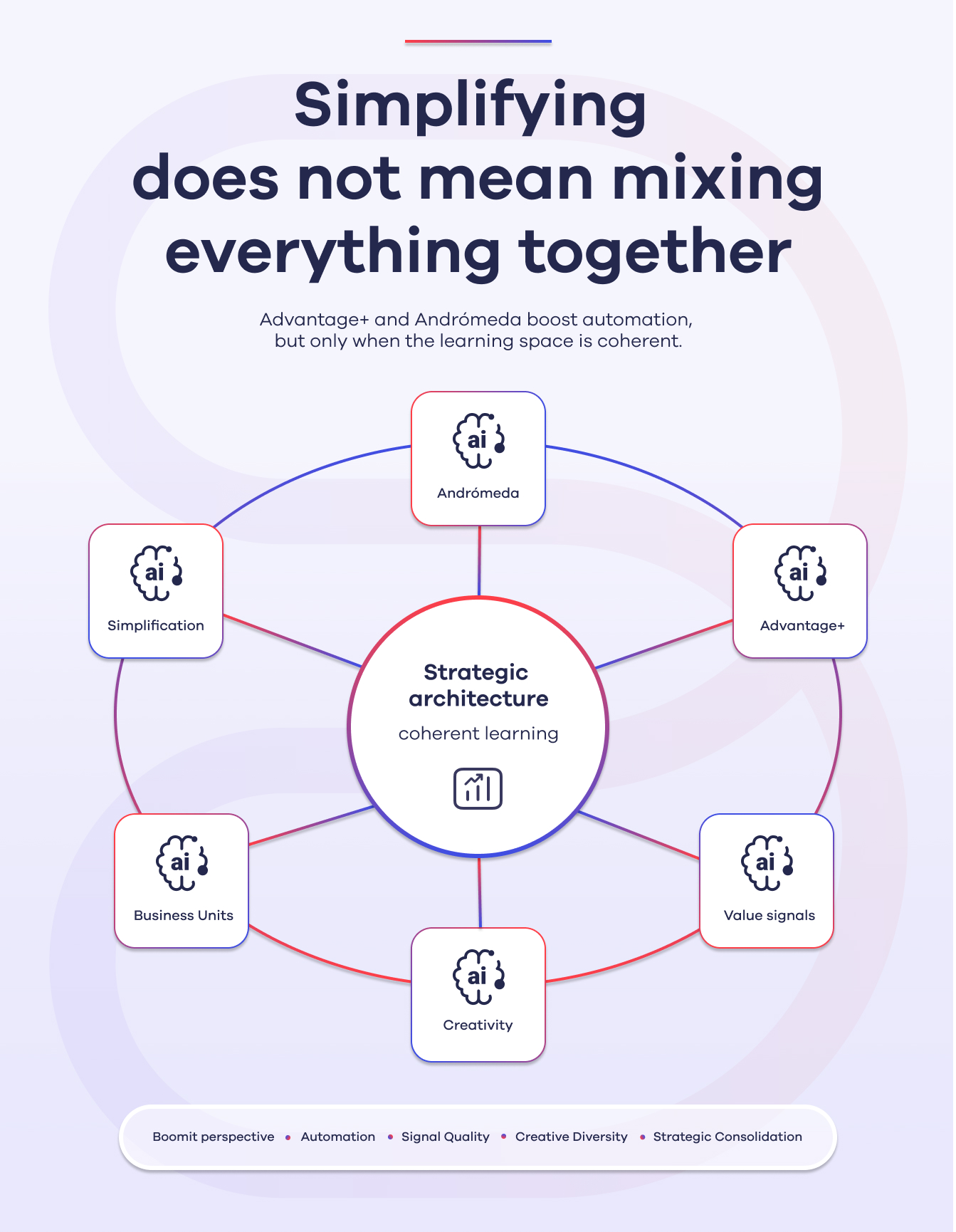
How we do it at Boomit: Learning Equivalence Model
At Boomit, we work with Meta Ads automation through a data, creativity, and performance logic. We do not see Advantage+ as a magic box. We see it as a powerful tool when the account is well designed.
To organize that decision, we use a Learning Equivalence Model. The question is not “can I put these campaigns together?” The right question is: “do these campaigns teach the system something similar enough?”
When two products, audiences, events, or promises teach similar patterns, consolidation can improve learning. When they teach incompatible patterns, consolidation can contaminate it.
Each campaign should work as a learning territory: product, intent, creative promise, optimization event, business economics, journey friction, and quality signal.
Before consolidating campaigns in Meta Ads, we review these dimensions:
| Dimension | Can be consolidated when... | Should be separated when... |
|---|---|---|
| Product | The offer responds to the same need | Products solve different problems |
| Event | The event represents similar value | The same event groups different intents |
| Audience | User motivation is compatible | Intent changes radically |
| Economics | CPA and LTV are comparable | There are strong differences in margin or value |
| Journey | Friction and duration are similar | One journey is simple and another requires validation |
| Creative | Messages complement each other | Promises compete or contradict each other |
| Signal | Quality is evaluated with the same criteria | Each product needs different feedback |
CPA and LTV cannot be read in isolation. A low CPA can be good for a low-friction product, but bad if it attracts users with no downstream value.
Then we define the real unit of value. We do not accept “lead” or “registration” as an automatic answer. In fintech, banking, and apps, the event that matters is usually deeper in the funnel: funded account, activated card, first transaction, approved application, disbursed loan, or active subscription.
If Meta cannot learn with enough volume from that event, we design a proxy close to real value. For investments, if “investment completed” has low volume, “funded account” or “KYC approved + funding intent” can be used. KYC, the customer identity verification process, only works if it is later connected to downstream quality.
Then we define architecture, creativity, and measurement. We separate when there are real differences in product, economics, friction, or intent. We consolidate when separation only responds to old manual segmentation practices. And we connect Pixel, Conversions API, CRM, MMP, and dashboards to optimize toward quality, not just volume.
Fintech example: cards, loans, and investments should not learn the same way
Suppose a regional fintech has three products: credit cards, personal loans, and investments.
A poor architecture would be creating a single campaign called “Fintech Growth,” optimized for leads, with ads from all three products competing for the same budget. At first glance, it looks efficient: more volume, more signals, and less fragmentation. But if everything is measured as “lead,” the system does not distinguish real value.
A healthier architecture would separate by learning unit. Credit cards should optimize toward approved applications or first transaction. Personal loans should target qualified applications or approved loans. Investments should look at first funding or investment completed.
This structure is still simple, but not simplistic. Automation operates within a strategic framework. Each campaign has a clear task, compatible signals, and creative aligned with a specific intent.
Creativity in the Andromeda era: no more cosmetic variations
In a more automated system, creativity is no longer just a persuasive asset. It also works as a signal.
Meta does not only see “an ad.” It sees text, image, video, format, response history, engagement, conversions, fatigue, context, and the relationship between the person and the promise. That is why a poor creative library limits learning, even with a good structure.
The common mistake is producing ten assets that say the same thing with different colors. That is not creative diversity. It is aesthetic repetition. The diversity that matters is angle diversity: problem, result, objection, education, comparison, or trust.
Each angle is a hypothesis: what motivation activates this type of user better? In Meta Ads, a good creative strategy is not just about feeding the algorithm with volume. It is about giving it semantically different options inside the right territory.
Common mistakes when using Advantage+ and automation in Meta Ads
The first mistake is believing that Advantage+ fixes a bad strategy. It can automate audiences, placements, budget, and creative combinations, but it cannot solve a wrong definition of value.
The second mistake is consolidating products that do not share intent. If a campaign mixes cards, investments, loans, and insurance under the same generic event, the system can optimize toward the easiest product to convert.
The third mistake is optimizing for leads without quality. In complex businesses, a cheap lead can become very expensive if it does not pass scoring, does not fund, does not buy, does not activate, or does not retain.
The fourth mistake is looking at CPA without LTV. Two products can have very different acquisition costs and still be equally profitable, or the opposite. Without downstream value, the reading remains incomplete.
Actionable checklist to redesign your Meta Ads architecture
Before consolidating or automating more, review these points.
Instrumentation
- Confirm that the main event represents real value and not just a superficial action.
Architecture
- Separate products when they have different economics, journeys, or intents.
- Consolidate when the only difference is a tactical audience.
Creativity
- Design demand angles, not just visual variations.
- Separate incompatible promises.
Performance
- Read CPA together with LTV, payback, margin, and quality.
Business
- Define which products can compete for budget and which need strategic control.
Conclusion: Meta rewards clarity, not blind simplification
Andromeda, Advantage+, and Meta Ads automation push advertisers toward a new way of operating: less manual microsegmentation, more signals, more creativity, and more trust in the system.
But trusting the system does not mean abandoning strategy. The more powerful the algorithm becomes, the more important the quality of the strategic input becomes.
If we give it clean signals, diverse creativity, and meaningfully consolidated structures, Meta can scale more efficiently. If we give it incompatible products in the same pool, generic events, and creativity without hypotheses, it can learn a mix that looks good in the report and harms the business.
The future of Meta Ads is about building learning architectures: simple, clean, automatable, and designed around real units of value.
At Boomit, we help fintechs, banks, apps, and digital products design acquisition systems where data, creativity, and performance work around one question: not how to get more conversions, but how to acquire better customers with stronger business clarity.