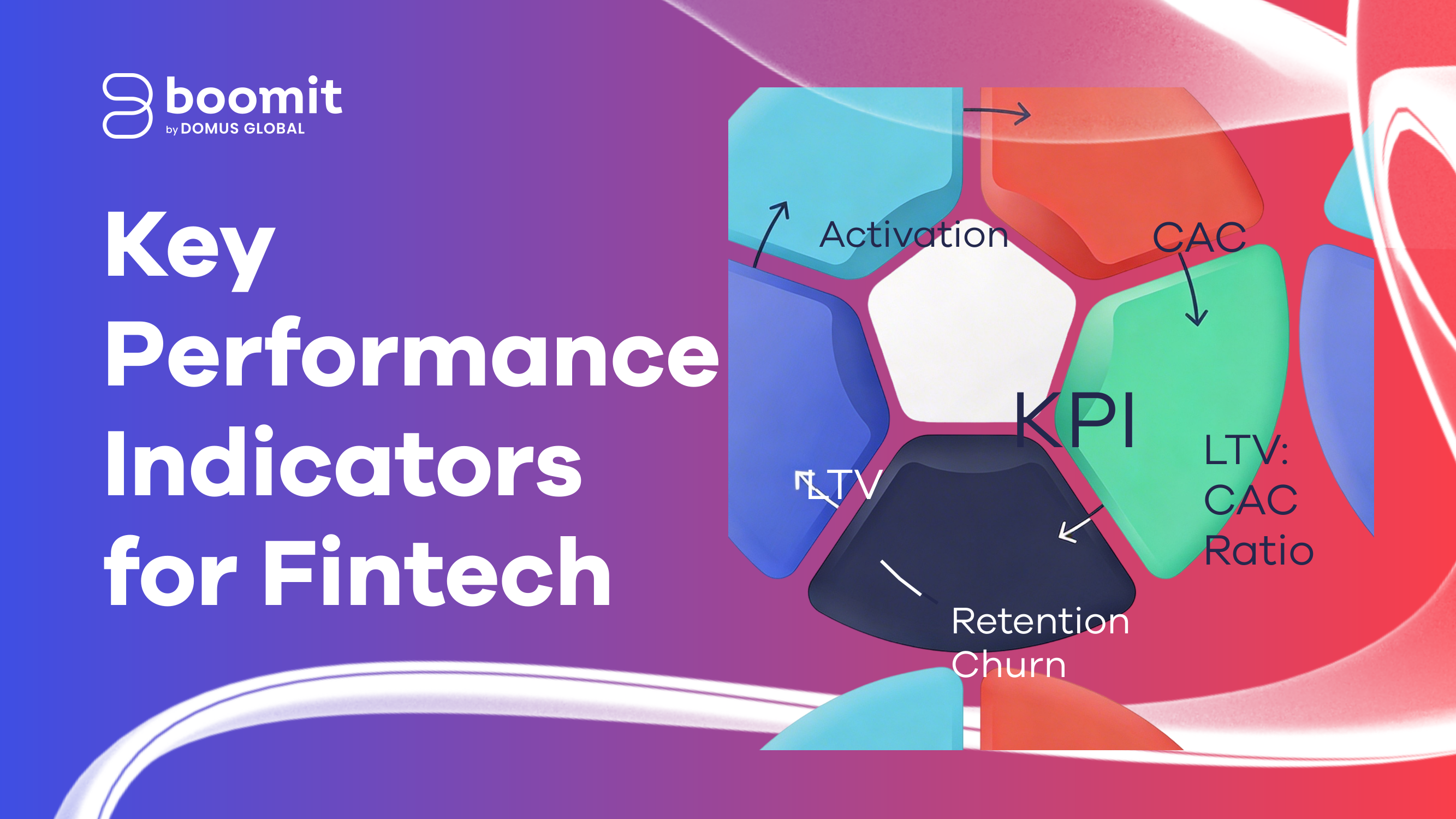


Measuring “growth” in a fintech is not counting sign-ups. It’s understanding whether you are acquiring users with real value signals, whether they activate, whether they stay, and whether unit economics hold.
In this guide you’ll learn what a KPI is, which fintech kpis matter most (only 5), and how to turn them into growth and performance decisions.
What is a KPI and why is it key to growth?
A KPI (key performance indicator) is a metric designed to evaluate whether a part of the business is meeting a specific objective. A KPI is not “any metric”: it has an owner, a cadence, a data source, and a threshold that triggers action.
In fintech, KPIs are critical because “gross” growth can hide expensive problems: low-quality acquisition, weak activation, or fragile retention. If your kpi fintech doesn’t help you decide, it’s just a nice number on a dashboard.
Essential fintech KPIs every financial company should track
KPI 1 — CAC
CAC (customer acquisition cost) measures how much it costs to acquire a new customer, including marketing and sales spend over a period. It’s the baseline to evaluate efficiency by channel, campaign, country and audience.
KPI 2 — LTV / CLTV
LTV/CLTV (customer lifetime value) estimates the economic value a customer generates across the relationship with your fintech. Depending on your business model, it may be driven by transactions, financial margin, fees, or subscriptions.
KPI 3 — LTV:CAC ratio
LTV:CAC is the relationship between value generated and acquisition cost. It’s used to validate whether you can scale spend without breaking profitability. If the ratio worsens as you scale, the issue is usually not “the channel” but signal quality, activation, or pricing.
KPI 4 — Activation (the key event)
Activation is the first event that proves real intent to use. In fintech it is often stricter than “sign-up”: first top-up, first transaction, first payment, first purchase, or first credit usage.
Activation connects marketing with product: if you attract the wrong audience or your onboarding has friction, you’ll pay “cheap” CAC for users who never activate (or activate with low quality).
KPI 5 — Retention and churn
Retention measures whether users come back and sustain usage. Churn (drop-off rate) measures who stops using or stops transacting. These are the temperature check of real value and determine realized LTV.
Below is a quick summary of the 5 metrics and the decision each enables:
| KPI | What it tells you | Typical growth decision |
|---|---|---|
| CAC | Acquisition efficiency by channel/cohort | Reallocate budget, adjust bids and targeting |
| LTV / CLTV | Expected or realized economic value | Set how much you can pay to acquire |
| LTV:CAC | Scalability and unit economics health | Scale or pause spend; refine offer or segmentation |
| Activation | Early quality and onboarding friction | Optimize funnel, creatives and campaign signals |
| Retention/Churn | Habit, recurrence and sustainability | Improve value prop, messaging and remarketing |
How to use these KPIs to improve your growth strategy
If you want your fintech kpis to be citable and actionable, use this 5-step process:
- Define activation as a single, auditable event aligned to the business (e.g., “first top-up” or “first transaction”).
- Measure by cohorts (channel, campaign, country, product) to avoid hiding issues behind averages.
- Separate leading vs lagging: activation and early retention are early signals; LTV and revenue often arrive later.
- Connect CAC with quality: “good” CAC without activation is expensive CAC. “high” CAC with strong activation can be scalable.
- Close the loop: every KPI must trigger a concrete action (pause, iterate creatives, change offer, adjust targeting, reduce onboarding friction).
How we do it at Boomit
At Boomit we treat KPIs as a decision system that connects performance + data + product. Our approach is simple: we don’t optimize for volume, we optimize for quality signals that better represent the ICP (ideal customer profile).
In practice, it usually looks like this:
- Instrumentation: we define activation and intermediate events (micro-conversions) to detect friction.
- Paid media: we test creatives and audiences with quality guardrails (activation and early retention) to avoid “buying” cheap users who don’t matter.
- Continuous optimization: we move budget based on cohorts (not averages) and validate impact on LTV:CAC.
Common mistakes / what to avoid
- Optimizing for sign-ups when true activation happens later (top-up/transaction).
- Looking at CAC without quality: lower CAC may mean worse traffic.
- Using LTV without a horizon: LTV at 30/90/180 days changes spend decisions.
- Comparing channels with different maturity windows: early LTV can be misleading.
- No thresholds: without thresholds there is no action; without action there is no KPI.
Actionable checklist
Instrumentation
- Activation defined as 1 single measurable event
- Cohorts ready by channel/campaign/country
- Measurement windows agreed (e.g., 7/30/90 days)
Funnel
- Activation rate by cohort visible
- Early retention (D7/D30) monitored
- Churn clearly defined (inactivity vs lower transacting)
Paid
- CAC by cohort (not only by campaign)
- Budget allocation rules based on activation and retention
- Creative tests with explicit hypotheses
Business
- LTV and LTV:CAC calculated with documented assumptions
- Scale/pause decisions linked to LTV:CAC
Conclusion + CTA: Optimize your growth strategy with Boomit
The most useful fintech kpis are not many: CAC, LTV, LTV:CAC, activation and retention give you the minimum read to grow with control. The key is cohort measurement, clear thresholds, and turning each KPI into a decision.
If you want to improve measurement, boost activation and scale paid media with quality signals, see our Fintech & Banking Marketing Services page.