


Measuring ROI in fintech isn’t just plugging numbers into a formula: it’s deciding which revenue counts, which costs belong in the equation, and which event truly represents value (because sign-ups or installs rarely equal profitability). If you measure it wrong, you can scale “cheap” campaigns that bring users who never pass KYC, never fund their account, or carry higher risk.
Below is a simple, fintech-ready method to calculate ROI and improve it with actionable metrics.
What is ROI and why it matters in fintech campaigns?
ROI (return on investment) shows how much you gain or lose relative to what you invested. The standard formula is:

In fintech, ROI matters because there’s friction (KYC, approvals, onboarding) and risk (fraud, chargebacks, delinquency) between a click and real money. If you optimize only for volume, “performance” can rise while profitability drops.
Quick comparison table (to choose what to track):
| Metric | What it answers | Useful for | Common fintech risk |
|---|---|---|---|
| ROI (return on investment) | “Did we make money?” | real profitability | missing hidden costs |
| ROAS (return on ad spend) | “Did ads pay back?” | media optimization | ignores non-ad costs |
| CAC (customer acquisition cost) | “How much per customer?” | scaling control | defining “customer” too early |
| LTV (lifetime value) | “How much value over time?” | long-term strategy | projections without cohorts |
How to calculate ROI in fintech step by step
The formula is easy; the hard part is building solid inputs for attributed revenue and total investment.
1) Define the “value event”
Pick the event that reflects real economic value, for example:
- KYC approved + first deposit/funding
- first card purchase
- first installment paid (lending)
2) Build your variables
Attributed revenue (net): fees, interchange, subscriptions, financial margin (if applicable), net collections (if applicable).
Total investment: ad spend + creative production/fees + incentives + variable funnel costs (e.g., paid KYC verification) + fraud/abuse costs when promos are exploited.
3) Example
- Ads: USD 30,000
- Creative/fees: USD 5,000
- Incentive: USD 5 per first funding × 2,000 fundings = USD 10,000
Total investment: USD 45,000
Attributed revenue in 60 days: 2,000 users with first funding × USD 30 net average (60 days) = USD 60,000
ROI = [(60,000 − 45,000) / 45,000] × 100 = 33.33%
4) 7 steps
- Define the value event and measurement window (30/60/90 days).
- Connect campaign → user → event (attribution).
- Measure net revenue by cohort (not overall averages).
- Add total investment (include incentives and variable costs).
- Calculate ROI by channel/campaign.
- Split by quality (approved vs rejected; funders vs non-funders).
- Turn it into action: scale, pause, or redesign offer/creatives/targeting.
Key metrics to calculate ROI in fintech marketing
ROI becomes actionable when you can explain it through levers. These metrics usually unlock optimization:
- CPA (cost per acquisition): cost per defined action (ideally the value event).
- CVR (conversion rate): per stage (click → sign-up → KYC → activation → value).
- Payback: days to recover the investment by cohort.
- Net margin per user: revenue minus variable costs (including incentives).
- Risk: fraud/abuse, chargebacks, delinquency (if applicable).
How we do it at Boomit
At Boomit we use the Boomit Fintech R.O.I. Model (4 layers):
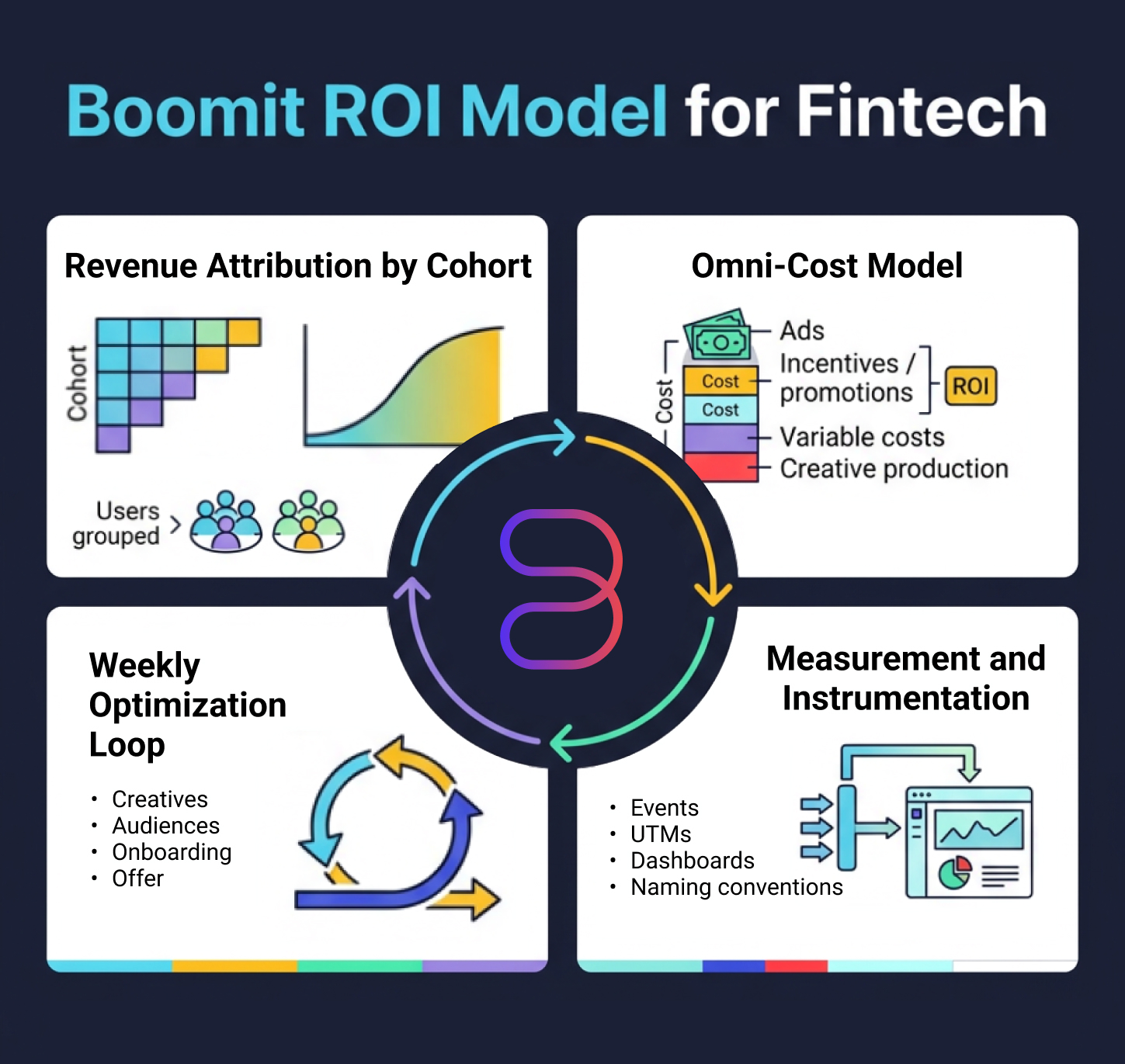
- Net attributed revenue by cohort.
- All-in costs (ads + incentives + variable costs + creative).
- Instrumentation (events, UTMs, naming, dashboards).
- Weekly feedback loop (creatives, audiences, onboarding, offer) to increase ROI without inflating risk.
Common mistakes / What to avoid
The biggest mistake isn’t “calculating ROI wrong,” but optimizing acquisition around a metric that doesn’t represent real money. If your campaign wins on sign-ups, installs, or even “loans disbursed,” but loses on net monetization, ROI will lie to you.
1) Optimizing for sign-ups/installs and calling it conversion
A sign-up is intent, not value. When the algorithm learns your goal is “sign-ups,” it will bring you cheap volume that completes forms, but doesn’t necessarily pass KYC (identity verification) or reach the event that actually pays the bills (first funding, first purchase, first installment paid). Typical outcome: CPA (cost per acquisition) drops, “performance” looks better… and payback stretches—or breaks entirely.
2) Optimizing for “loans disbursed” without measuring end-to-end quality
This is the classic one. Disbursing a loan doesn’t mean the user is profitable. You may be buying a cohort that moves fast through the funnel, but doesn’t generate net revenue because it carries higher risk or lower ability to repay.
Example:
You scale because “loans disbursed” improves and CPA per disbursement drops. A few weeks later, when you look at the full picture, you find that cohort:
- has a lower first-payment rate (your early signal of real monetization),
- delinquency rises (so expected revenue gets revised downward),
- operational cost increases (collections, support, extra validations, potential fraud).
The campaign “won” at the top of the funnel, but lost on margin: real ROI falls (or turns negative).
3) Calculating ROI with averaged revenue and no cohorts
If you attribute revenue using global averages (or without separating by channel/cohort), you hide the problem: different campaigns buy different quality. In fintech, ROI becomes actionable when you can read it by cohort and by value event—not as a pretty average.
4) Leaving costs out of total investment
Incentives (cashback/bonuses), variable funnel costs (for example, paid verifications), and promo abuse costs can eat your profitability. If they’re not included, your ROI is inflated and you end up making the wrong decisions.
Mini-check to avoid these mistakes
Define a value event that includes quality (e.g., KYC approved + activation), measure monetization by cohort, and add full costs (ads + incentives + variable costs). Then ROI stops being a reporting number and becomes a tool to decide when—and how—to scale.
Actionable checklist
Instrumentation & data
- Value event defined and tracked (KYC approved + activation).
- Consistent naming and UTMs across channels/campaigns.
Funnel & friction
- CVR by stage (click → sign-up → KYC → activation → value).
- One prioritized hypothesis for the main bottleneck.
Paid media
- Optimize to the value event once volume allows.
- Separate creatives by funnel stage (discovery vs intent).
Offer & incentives
- Incentive modeled as a real cost (with anti-abuse rules).
- Measure incremental uplift vs incremental cost.
Business
- Net attributed revenue by cohort (not overall average).
- ROI by channel/campaign + payback by cohort to decide scaling.
Improve your fintech campaign ROI with Boomit
Calculating ROI in fintech means aligning measurement with real money: value event, net revenue, and full costs. When those are in place, ROI stops being a “nice” reporting number and becomes a lever to scale with control.
If you want to improve ROI without buying cheap low-quality volume, see how we do it at Boomit with our Marketing Services for Fintech and Banks.