

Investing more in advertising does not always mean growing better. If a brand increases traffic to its website, landing page, or app, but the experience does not convert, a significant part of the budget is lost before generating real results.
That is where a CRO strategy comes in. CRO stands for Conversion Rate Optimization, and it helps improve the performance of digital assets so more users complete relevant actions: signing up, buying, requesting a demo, downloading an app, filling out a form, or moving forward in an onboarding flow.
For marketing, Growth, and performance teams, CRO should not be seen as an isolated visual adjustment. It is a methodology to detect friction, improve user experience, and increase the efficiency of each acquisition channel. In other words: it is not just about bringing more traffic, but about converting the traffic you are already generating more effectively.
In this article, we will explain what CRO means, why it matters for a digital business, what types of conversions exist, which metrics to track, which strategies to apply, and how to build a step-by-step, data-driven CRO methodology.
What Does CRO Mean?
CRO stands for Conversion Rate Optimization. It is the process of improving a website, landing page, app, or digital funnel so that a higher percentage of users complete a valuable action for the business.
That action can vary depending on the type of company. In ecommerce, a conversion may be a purchase. In fintech, it may be an account creation, an approved application, or a first deposit. In an app, it may be an install, a registration, a subscription, or the use of a key feature. In a B2B company, it may be a booked demo or a qualified lead.
That is why a CRO strategy does not start by changing buttons or redesigning screens. It starts by defining which conversion matters and what value it represents for the business. Optimizing for more completed forms is not the same as optimizing for more profitable customers. Improving clicks is not the same as improving activation.
At Boomit, we often see this problem in campaigns that generate volume, but not necessarily quality. For example, a landing page may generate many registrations, but only a few users move to the next step. An app may acquire installs at a good cost, but lose users during onboarding. A fintech company may attract cheap leads, but with low probability of approval or activation.
In all these cases, the problem is not solved only by buying more traffic. It is solved by understanding where the experience breaks, which messages are not aligned, which steps create friction, and which intent signals help identify users with higher potential.
CRO is, ultimately, a way to make marketing work better. It helps every visit, click, or install have a greater chance of becoming a useful action for the business.
Why Is a CRO Strategy Important for Your Business?
A CRO strategy is important because it improves results without depending only on increasing advertising investment. If the traffic already exists, but the website, landing page, or app does not convert well, the business is losing opportunities inside its own funnel.
For marketing and Growth teams, this directly impacts efficiency. An improvement in conversion rate can reduce CPA (cost per acquisition), improve CAC (customer acquisition cost), and increase campaign returns without doubling the budget.
But CRO should not be measured only by the number of conversions. It also has to look at the quality of those conversions. In digital products, fintech, banking, or apps, getting more registrations is not enough if those users do not move forward, activate, buy, deposit funds, or generate value afterward.
For example, a campaign may generate a large volume of low-cost leads, but if the sales team finds that only a few match the target profile, the problem is not only acquisition. There may be a disconnect between the ad message, the landing page promise, and the type of user the product actually needs.
A CRO strategy helps identify that disconnect. It allows teams to review the full journey: from the first ad to the value event. This way, the team can detect where intent is lost, which parts of the process create friction, and which messages attract users with a higher probability of becoming real customers.
At Boomit, we understand CRO as a key layer within a performance strategy. It is not about making a page convert more in isolation, but about improving the profitability of the acquisition system. When the funnel converts better, every dollar invested in media has a greater chance of becoming measurable growth.
Types of Conversions in a CRO Strategy
Not all conversions have the same value. That is why, before optimizing a conversion rate, it is necessary to define which action needs improvement and what that action means for the business.
In a CRO strategy, we can distinguish between macro-conversions and micro-conversions.
A macro-conversion is the main action we want the user to complete. It is usually directly connected to the business goal. It may be a purchase, a subscription, a booked demo, an account creation, a first deposit, a submitted application, or a contract.
A micro-conversion is an intermediate action that shows progress or intent. It does not necessarily represent the final result, but it helps understand whether the user is moving forward in the funnel. It may be clicking a CTA (call to action), visiting a pricing page, starting a form, downloading a resource, watching a video, adding a product to cart, or completing one step of onboarding.
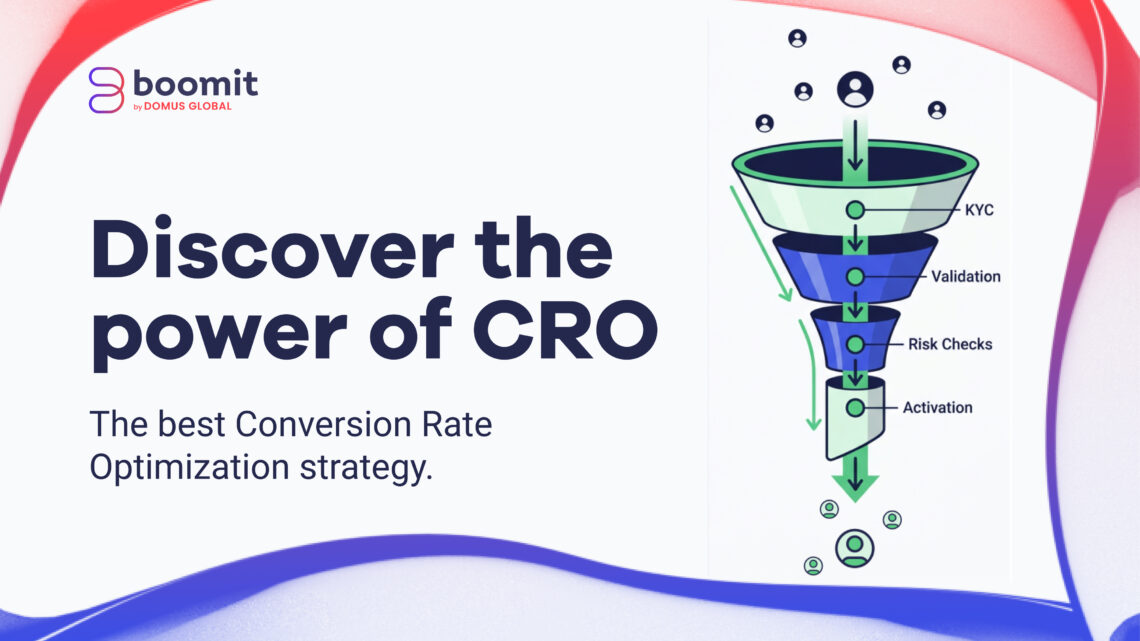
This distinction is key because many digital funnels do not convert in a single interaction. In fintech, for example, a user may see an ad, enter a landing page, start a registration, validate data, download the app, and only then complete a first deposit. If we only look at the final deposit, we may miss valuable information about where the process breaks.
The same happens in apps. An install is not always a sufficient conversion. It may be the first step, but the real value appears when the user registers, enables permissions, completes onboarding, uses a key feature, or starts a subscription.
That is why a strong CRO strategy does not optimize only the last step. It analyzes the full journey and defines which intermediate conversions help anticipate quality. This allows better decisions across campaigns, landing pages, forms, product, and messaging.
Key Metrics to Measure a CRO Strategy
The best-known metric in a CRO strategy is the conversion rate. It is calculated by dividing the number of conversions by the total number of visitors, sessions, or users, and multiplying the result by 100.
For example, if a landing page receives 10,000 visits and generates 500 registrations, the conversion rate is 5%.
However, looking only at this metric can be insufficient. A high conversion rate does not always mean the business is growing better. If conversions lack quality, if users abandon after registration, or if acquisition costs remain high, the team needs to look deeper.
Some key metrics to evaluate a CRO strategy are:
- Conversion rate: measures what percentage of users complete a specific action.
- CPA (cost per acquisition): shows how much it costs to obtain a specific conversion.
- CAC (customer acquisition cost): measures how much it costs to acquire a real customer.
- ROAS (return on ad spend): helps understand how much revenue is generated by paid media investment.
- LTV (lifetime value): estimates how much value a customer generates during their relationship with the company.
- Abandonment rate: shows at which stage users leave the process.
- CTR (click-through rate): measures the percentage of users who click on an ad, link, or CTA.
- Activation: indicates whether the user completed an action that shows real product usage.
The point is not to measure everything at once, but to choose the metrics that support decision-making. A mature CRO strategy combines conversion, cost, and quality metrics. That combination helps improve performance without falling into the trap of optimizing only for volume.
7 CRO Strategies to Improve Conversion Rate
An effective CRO strategy does not depend on a single change. Improvement usually appears when several layers of the funnel are worked on: message, experience, trust, speed, forms, segmentation, and measurement.
1. Optimize the Value Proposition
The value proposition should quickly answer what the brand offers, who it is for, and why the user should move forward. On a fintech landing page, for example, saying simple financial solutions is not enough. It is better to explain which problem is being solved: access to credit, digital accounts, payments, investment, or financial management.
2. Align Ad, Landing Page, and CTA
One of the most common frictions appears when the ad promises one thing and the landing page communicates another. If a campaign talks about opening a digital account in minutes, the landing page should reinforce that message above the fold. The CTA should also be consistent: Create my account may work better than a generic Submit.
3. Reduce Friction in Forms and Onboardings
Each additional field can affect conversion, but not every field should be removed. The key is to ask for the right information at the right moment. If sensitive data is necessary, it is useful to explain why it is being requested.
4. Improve Speed and Mobile Experience
Most users will not wait for a slow page to load or struggle with a form that is uncomfortable on mobile. A CRO strategy should review load speed, visual hierarchy, readability, buttons, forms, and mobile navigation.
5. Add Trust Signals
Trust is a conversion factor, especially when the user has to share personal data, financial information, or make a purchase decision. Testimonials, partner logos, reviews, certifications, security messages, clear policies, and social proof can help reduce uncertainty.
6. Personalize Messages by Segment
Not all users arrive with the same intent. Personalization can start with landing pages by vertical, messages by audience, or CTAs adapted to the funnel stage.
7. Test Hypotheses With Data
CRO should not be based on opinions. Every change should respond to a clear hypothesis: what we believe is happening, what we will modify, and which metric will show whether it worked.
How to Create a CRO Strategy Step by Step
For CRO to work, it needs method. At Boomit, we use a working logic that can be summarized as the CRO Loop method: diagnose, prioritize, design, test, and scale.
1. Diagnose the Funnel
The first step is to understand where value is being lost. To do that, teams need to review traffic data, conversion rates, abandonment by stage, behavior by device, acquisition sources, and user quality.
2. Prioritize Opportunities
Once frictions are detected, the team must decide what to work on first. A good prioritization process considers three variables: potential impact, implementation effort, and available evidence.
3. Design Hypotheses
A CRO hypothesis should explain what problem needs to be solved and why a change could improve conversion. For example: if users abandon the form when asked for financial information, then adding explanatory microcopy and splitting the process into steps could increase completion without losing quality.
4. Test Changes
The test may be an A/B test, a copy test, a design improvement, a new landing page structure, or an onboarding modification. Before launching, the main metric must be defined.
5. Scale Learnings
CRO does not end when a test wins. If a value proposition converts better on a landing page, it can be used in ads. If an audience responds better to a specific message, it can guide campaigns.
Tools to Implement CRO Strategies
Tools help execute a CRO strategy, but they do not replace judgment. Before choosing software, it is better to define what needs to be understood: behavior, measurement, experimentation, attribution, or commercial quality.
For analytics and measurement, Google Analytics 4, Looker Studio, Mixpanel, or Amplitude can help visualize events, audiences, funnels, and user behavior.
To understand on-page behavior, tools such as Hotjar, Microsoft Clarity, Crazy Egg, or Mouseflow allow teams to analyze heatmaps, session recordings, clicks, scroll depth, and abandonment.
For experimentation, platforms such as VWO, Optimizely, AB Tasty, or Convert allow teams to run A/B tests, multivariate tests, and personalizations. In apps, Firebase A/B Testing can be a useful alternative.
For mobile measurement and attribution, tools such as AppsFlyer, Adjust, or Singular help connect campaigns with installs, in-app events, and user quality.
To connect marketing with sales, a CRM (customer relationship management) platform such as HubSpot, Salesforce, or a similar solution can help understand whether converted leads are truly useful for the sales team.
When Should You Hire a CRO Agency?
It makes sense to hire a CRO Agency when the business already has traffic, advertising investment, or an active funnel, but is not converting with the expected efficiency.
This usually happens when campaigns generate visits but few conversions, when forms have high abandonment, when leads lack quality, or when it is not clear whether the problem is in paid media, UX, data, content, or product.
Checklist to Know If Your Business Needs a CRO Strategy
- You receive qualified traffic, but the conversion rate is low.
- You invest in paid media, but CPA or CAC keeps increasing.
- You have many registrations, but few users activate or buy.
- The sales team receives low-quality leads.
- You do not know at which stage of the funnel most users drop off.
- Your landing page communicates generic benefits instead of a clear value proposition.
- The form has high abandonment or asks for too much information without context.
- The mobile experience converts worse than desktop.
- There is no testing system or documentation of learnings.
- Optimization decisions are based on intuition instead of data.
How Boomit Works on a CRO Strategy
At Boomit, we work on CRO strategies through a combination of data, creativity, and performance. Our goal is not only to improve an isolated rate, but to make the acquisition system convert better and generate higher-value users.
First, we review the measurement architecture. We analyze events, conversions, traffic sources, campaigns, landing pages, forms, CRM, attribution, and post-conversion behavior.
Then we analyze the user experience. We look for friction in messaging, navigation, forms, speed, trust, onboarding, and the consistency between ad and destination.
Then we build prioritized hypotheses. We do not propose random changes: we design an experiment roadmap based on expected impact, effort, and connection to business metrics.
Finally, we connect learnings with performance. If a message converts better, it can be scaled into campaigns. If a segment shows higher intent, it can feed audiences.
Conclusion: Convert More With a Data-Driven CRO Strategy
A CRO strategy helps convert better without depending only on increasing budget. It helps detect friction, improve user experience, and make each acquisition channel work more efficiently.
For digital businesses, fintech, banking, and apps, this is especially important. Conversion does not end with the click or the registration. The real value appears when the user moves forward, activates, buys, deposits, subscribes, or shows real intent.
At Boomit, we help digital companies improve their conversion funnels with an integrated Growth and performance perspective. If your team is already generating traffic, but feels the funnel is still losing too much value, a CRO strategy may be the next step to grow more efficiently.