

Meta Ads can no longer be understood as a platform where advertisers define an audience, upload ads, and wait for results. Today, it works as a large-scale recommendation system: it decides, in milliseconds, which ad to show to which person, on which surface, in which format, and with what probability of generating value.
For Growth Marketing, especially in fintech and banking, understanding this infrastructure is not a technical detail. It is a strategic advantage.
When we do not understand how the system learns, we optimize symptoms. We pause ads too early, mix incompatible products, choose the wrong events, or confuse a low CPA (cost per acquisition) with real business impact. Boomit’s thesis is simple: on Meta, the team that designs the learning system better wins.
What changed in Meta Ads: from advertising platform to recommendation system
For years, many teams operated Meta Ads as a segmentation platform. The logic was to choose interests, create lookalike audiences, split ad sets, adjust budgets, and search for the winning ad.
That logic has lost strength. With broader audiences, Advantage+, and systems like Andromeda, Meta is pushing toward less manual control and more algorithmic learning. This does not mean strategy disappears. It means it moves to a different place.
It is no longer about controlling every microsegment. It is about defining better which signal, creative, product, and event we give the system so it can learn.
How Meta’s advertising infrastructure works
When a person opens Instagram, Facebook, Reels, Stories, or Feed, Meta does not evaluate every possible ad with the heaviest model from the start. That would be slow and costly. The system works in stages.
First comes the universe of eligible ads: active campaigns, budgets, objectives, audiences, rules, creatives, and restrictions. Then comes retrieval, where that universe is reduced to a subset of relevant candidates. Next comes ranking, where the probable value of each ad is estimated.
Later comes the auction, and finally delivery, where the ad is shown on a specific surface. After the impression, the system receives feedback: clicks, views, conversions, server-side events, CRM (customer relationship management system) signals, quality, and downstream value.
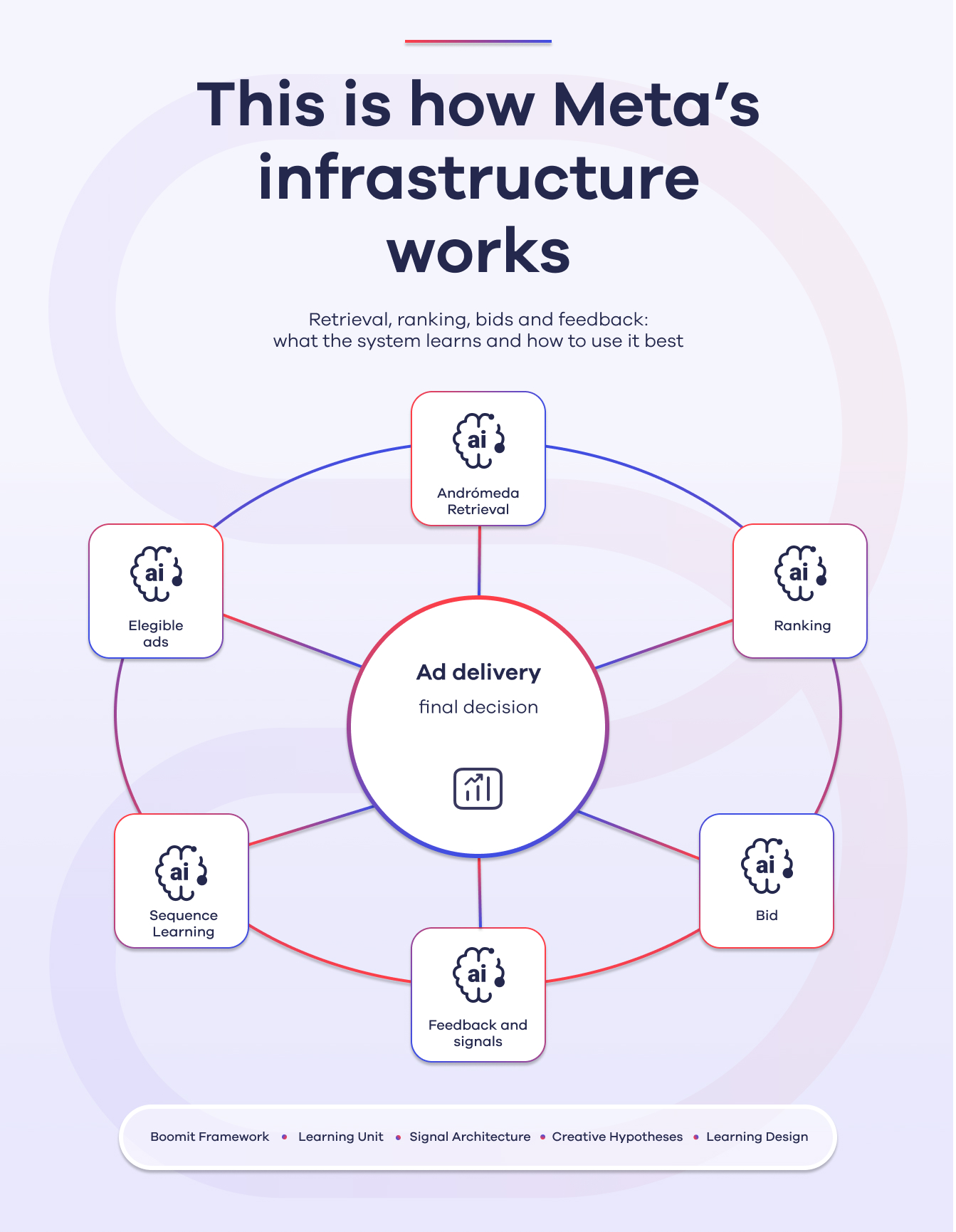
For a Growth team, the implication is clear: a campaign is not just a budget structure. It is a source of candidates, signals, and learning.
Why this matters for Fintech and Banking Growth
In fintech and banking, not all conversions have the same value. A registration is not the same as an approved KYC. A lead is not the same as an activated card. An opened account is not the same as a funded account.
KYC (Know Your Customer, the customer identity verification process) can be a useful intermediate signal, but it does not necessarily represent final value. The same happens with a completed form: it can indicate intent, but not quality.
The problem appears when Meta only receives superficial events. If the system receives “lead,” it learns to get leads. If it receives “qualified lead,” it learns better. If it receives “approved customer,” it learns even better. If it receives “activated customer with value,” learning gets closer to the business.
This does not mean we should always optimize for the deepest event from day one. Often, there is not enough volume. But it does mean the measurement architecture must progressively move closer to real value.
In financial products, the challenge is to design signals that combine volume and quality. An event that is too superficial creates noise. An event that is too deep may have low frequency or too much latency. The balance lies in choosing an intelligent proxy: an intermediate action that represents real intent.
How we do it at Boomit: Advertising Learning Framework
At Boomit, we work with Meta Ads as a learning infrastructure, not just as an acquisition channel. For that, we use a five-layer framework: Business Learning Unit, Signal Architecture, Creative Hypothesis Map, Campaign Learning Design, and Decision System.
The Business Learning Unit is the smallest unit worth learning about. It can be a product, a value segment, a strategic audience, or a specific moment in the journey. In a fintech, for example, credit cards, investments, loans, and remittances are usually different units.
If they have different LTV (lifetime value), different acceptable CPA, different friction, and different promises, they should not be evaluated within the same learning pool.
Signal Architecture defines which events are sent to Meta and which are used for optimization, analysis, and feedback. In an investment app, the superficial event can be CompleteRegistration. Intermediate events can be KYCStarted, KYCApproved, or BankAccountLinked. Value events can be FirstDeposit, InvestmentCompleted, DepositAmount, or Revenue30D.
The key is not to confuse the optimization event with the only important event.
The Creative Hypothesis Map organizes creativity as hypotheses, not as isolated assets. For investments, one hypothesis can be yield, another security, another liquidity, another financial education, and another protection against inflation.
The question is not only “which ad had the best CTR (click-through rate).” The right question is: which demand hypothesis did we validate?
Campaign Learning Design translates those hypotheses into a simple, automatable, and coherent structure. We do not look for unnecessary complexity. We look for Meta to learn fast without contaminating the learning process.
If investments and credit cards have different promises, events, and economics, they need separate spaces, even if both campaigns use broad audiences or Advantage+.
The Decision System defines in advance how we are going to make decisions. Learning fast does not mean deciding impulsively. It means knowing what evidence we need to scale, iterate, separate, consolidate, or discard a hypothesis.
Applied example: investment fintech
Suppose a fintech needs to increase funded accounts, not just registrations. The mistake would be to optimize everything for CompleteRegistration and celebrate a low CPA. That result may look efficient in the dashboard, but it does not necessarily generate business.
A more rigorous architecture could define the Business Learning Unit as “Investments.” The ideal event would be FirstDeposit or InvestmentCompleted. If there is not enough volume, the proxy could be KYCApproved + BankAccountLinked.
The campaign could use a broad audience or Advantage+ audience, but with a creative library organized by hypotheses: yield, security, liquidity, education, and protection against inflation.
The analysis should not stop at registration CPA. It should look at CPA for approved KYC, CPA for funded account, funded amount, time to funding, and 30-day retention.
This leads to better decisions. If the education angle lowers KYC CPA but does not generate funding, it can work for remarketing or mid-funnel content. If security generates less volume but a higher funded amount, it may justify a higher CPA. If yield generates many registrations but a low average amount, quality by cohort must be analyzed before scaling.
That is the difference between superficial performance and rigorous growth.
Common mistakes / What to avoid
- Thinking that automation replaces method. Advantage+ can automate audiences, placements, and creative combinations, but it does not define by itself what represents business value.
- Mixing incompatible learning units. Cards, investments, loans, and insurance can belong to the same brand, but not necessarily to the same demand system.
- Optimizing for superficial events without measuring downstream quality. A cheap lead can become very expensive if it does not pass scoring, fund, activate, or generate revenue.
- Deciding based on CTR or CPA without looking at LTV, margin, payback, and quality. An asset with lower volume can bring higher-value users.
- Producing creative as aesthetic variations. Changing colors or formats is not enough. Each asset should represent a demand hypothesis.
Actionable checklist
Before redesigning your Meta Ads account, review these points.
Learning unit
- Define which product, segment, or journey moment deserves to be learned separately.
Signal
- Identify the ideal event, the proxy event, and the downstream quality events.
Creative
- Organize assets by hypothesis: yield, security, urgency, trust, comparison, education, or friction.
Architecture
- Separate what teaches different things and consolidate what teaches equivalent things.
Measurement
- Connect Pixel, Conversions API (application programming interface to send events from the server), CRM, MMP (mobile measurement platform), and dashboards to read quality, not just volume.
Decision
- Define in advance when to scale, iterate, pause, separate, or consolidate.
Conclusion
Meta’s infrastructure is becoming increasingly powerful. Andromeda improves the retrieval of relevant ads. Sequence learning helps the system better understand behavioral journeys. Advantage+ automates audiences, placements, budget, and creative combinations.
But everything depends on the quality of the strategic input.
To maximize ROAS (return on ad spend) and business impact, advertisers must design the learning process. That means separating what teaches different things, consolidating what teaches equivalent things, sending signals close to real value, creating content as hypotheses, and measuring beyond superficial CPA.
In fintech and banking, the secret is not only to optimize campaigns. It is to learn faster than the market which promises, products, audiences, and signals generate real value.
Meta provides the infrastructure. The Growth team defines what the system should learn.
At Boomit, we help fintechs, banks, apps, and digital products turn Meta Ads into a business-connected learning system: data, creativity, and performance working around one question, not how to get more conversions, but how to acquire better customers.