

Understanding the differences between customers helps you develop more relevant and efficient marketing strategies.
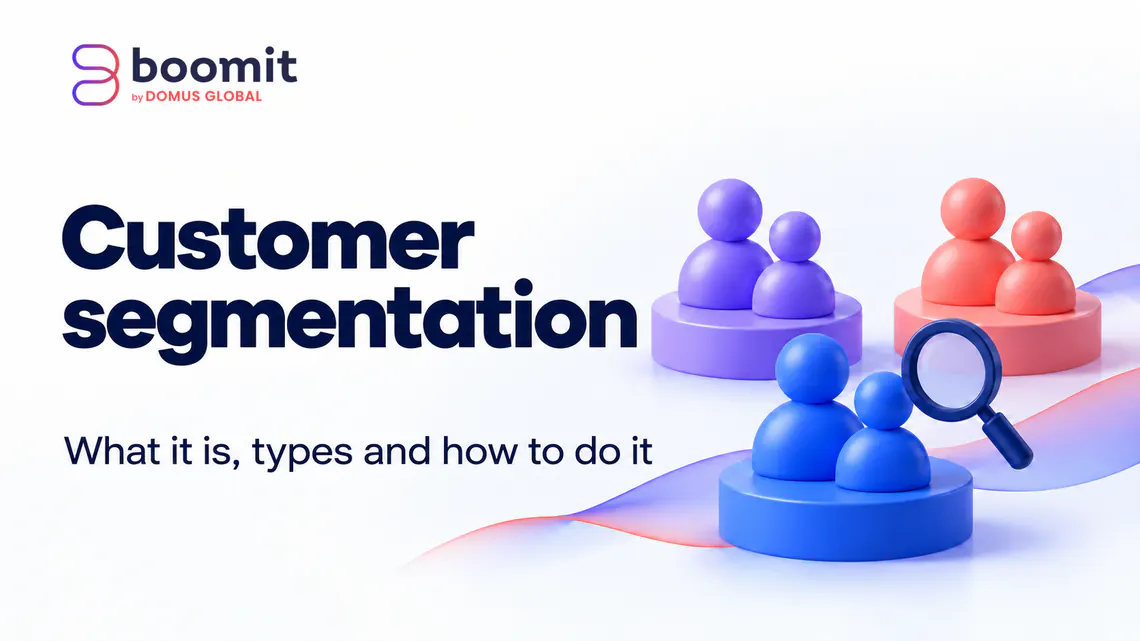
Customer segmentation means dividing an audience into groups with similar characteristics, needs, or behaviors. It helps identify business opportunities, personalize messages, and direct campaigns toward audiences with greater conversion potential. Effective segmentation helps optimize advertising investment and improve the quality of acquired customers.
What is customer segmentation, and what is it used for?
In digital marketing, this practice makes it possible to move from broad, generic campaigns to data-driven actions, considering not only who users are, but also how they interact with a brand and the value they can bring to the business.
Getting your segmentation right can lead to:
- Greater relevance: adapt messages and value propositions to each audience.
- Better advertising investment: prioritize segments with greater business potential.
- More conversion opportunities: identify users based on their needs and purchase intent.
- Continuous optimization: analyze which segments deliver better results and adjust campaigns.
However, more segmentation does not always mean better segmentation. An overly narrow audience can increase advertising costs and make it harder for algorithms to learn.
The goal is to find the balance between relevance, reach, and profitability.
Which criteria are used to segment customers?
There are different types of customer segmentation. The choice depends on the product, business objectives, and available information.
1. Demographic segmentation
Groups customers by characteristics such as age, occupation, education level, or income.
It is useful for identifying broad profiles, although these attributes do not always reflect actual intent to sign up for a product. Keep in mind that two people with similar incomes may have completely different financial needs.
2. Geographic segmentation
Classifies audiences by location.
It is especially relevant for companies operating in different markets, where regulations, consumer habits, and product availability vary.
A fintech with a regional presence can adapt its campaigns to the specifics of each country.
3. Psychographic segmentation
Considers interests, motivations, lifestyles, and values.
It helps explain why different people might choose the same product.
For example, an investment app can develop different messages for users interested in building wealth and those looking to diversify their savings.
4. Behavioral segmentation
Analyzes the actions users take: visits, sign-ups, purchases, interactions, or use of features.
It is particularly valuable because it identifies concrete signals of intent.
For example, users who started a loan application without completing it can receive communications through remarketing strategies designed to answer questions or make conversion easier.
5. Value-based segmentation
Classifies customers by their current or potential economic contribution.
It may consider variables such as purchase frequency, revenue generated, or Lifetime Value (LTV, the value a customer generates over their relationship with the business).
In performance marketing, it helps optimize campaigns toward users who contribute greater profitability, rather than focusing exclusively on conversion volume.
How do you segment customers step by step?
Effective segmentation requires combining business objectives, reliable information, and experimentation.
Step 1. Define your objectives
Before creating segments, you need to determine the desired outcome: increasing sign-ups, acquiring profitable customers, increasing transactions, or improving conversion.
The objective determines which characteristics are worth analyzing.
Step 2. Collect and analyze data
Integrate information from analytics tools, advertising platforms, customer relationship management (CRM) systems, and in-product behavior.
In banking and fintech, it is also important to incorporate post-sign-up signals, such as activations or first transactions, while respecting applicable privacy requirements.
Step 3. Identify patterns and build segments
Look for shared characteristics among users with similar behaviors or outcomes.
For example, distinguish between those who download an app, those who complete registration, and those who actually use the product.
Step 4. Design differentiated strategies
Define messages, creative assets, channels, and value propositions for each group.
Not every segment needs a separate campaign: sometimes, differentiating creative assets within broad audiences can deliver better results.
You can also identify a segment you want to exclude from the strategy.
Step 5. Measure and optimize
Evaluate indicators such as conversion rate, customer acquisition cost (CAC), the quality of acquired users, and LTV.
The results help identify which segments justify greater investment and which need adjustments.
Examples of customer segmentation in digital marketing
The following Boomit case studies show how different segmentation approaches can be applied to real growth challenges.
Example 1. Banpaís: value-based segmentation
In its savings deposit acquisition strategy, Banpaís needed to attract users who could contribute to deposit growth, rather than simply generate more contacts.
Boomit implemented a strategy combining value-based segmentation, creative work as a quality filter, and optimization focused on business outcomes.
Advertising messages were aligned with the product’s actual terms to support the acquisition of relevant users.
The case demonstrates how segmentation can improve acquisition quality when directly connected to business objectives.
Example 2. dLocal: segmentation for a global B2B strategy
For a payment infrastructure company such as dLocal, reaching the right organizations and decision-makers is essential.
Boomit develops its global advertising technology (AdTech), demand generation, and paid media strategy, combining brand positioning with actions aimed at strategic accounts.
This case shows how segmentation in business markets can be organized around target accounts, decision-maker profiles, and business opportunities, rather than being limited to demographic characteristics.
Explore the dLocal case study.
How can you tell whether a customer segment is useful for the business?
Not every group you identify justifies a separate strategy. To evaluate its usefulness, it is worth applying five criteria:
How we do it at Boomit: segmenting for growth
At Boomit, we approach segmentation through three complementary dimensions: data, creativity, and performance.
This means identifying relevant signals, developing messages aligned with each audience’s needs, and optimizing campaigns based on business outcomes.
The challenge is to find the segments that actually improve acquisition, rather than create as many segments as possible.
Common mistakes to avoid
Segmentation can become less effective when data is outdated, audiences are too small, or conversions are prioritized without considering their quality.
It is also important to avoid letting segments remain static: user behavior changes, and strategies need to evolve.
Improve customer segmentation and boost your campaigns with Boomit
A customer segmentation strategy helps you better understand audiences, personalize campaigns, and allocate budget toward opportunities with greater potential.
But its true value emerges when those segments translate into measurable marketing decisions.
At Boomit, we combine data, creativity, and performance marketing to develop acquisition strategies focused on business outcomes.
Discover how we can strengthen your campaigns through our Advertising and Marketing Agency for Fintech.