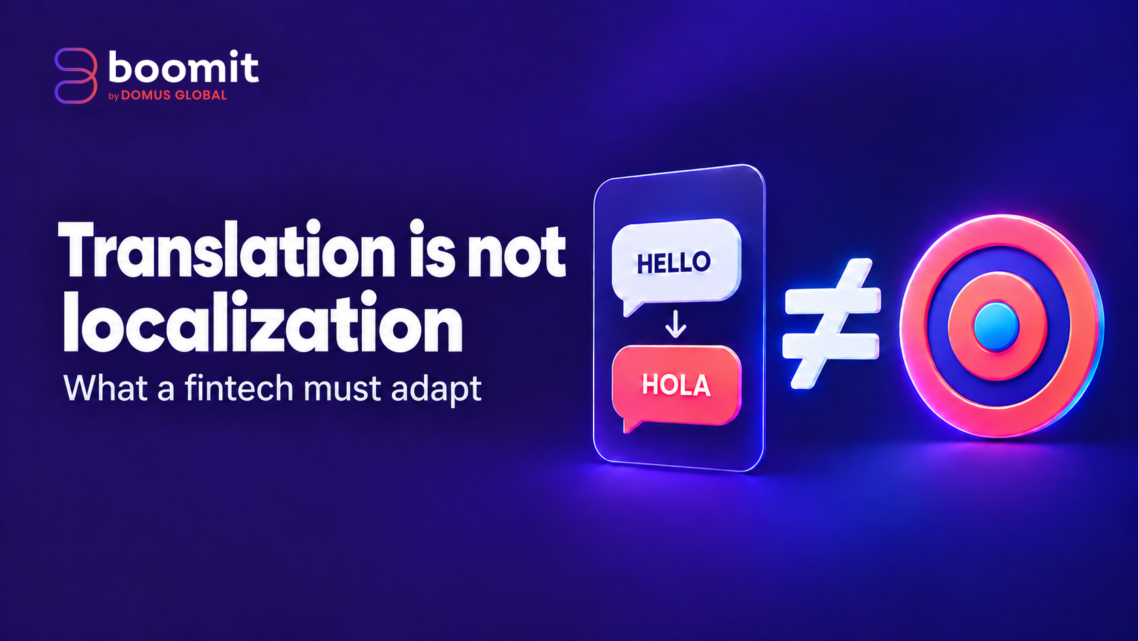


A fintech is not localized because its ads are in Spanish or Portuguese.
Real localization happens when the full system that turns attention into a valuable financial customer fits the country: regulation, onboarding, payments, offer, trust, creative, media and measurement.
This distinction matters because paid campaigns can look healthy at the top of the funnel while the business still fails to acquire valuable customers. The ads may be localized. The growth system receiving that traffic may not be.
What fintech localization actually means
For a financial product, localization is the process of adapting the customer journey and growth infrastructure to the reality of a specific market.
Language is part of that process, but usually not the hardest part.
Think about what happens between someone seeing an ad and becoming a valuable user. The person has to understand the proposition, trust the provider, complete Know Your Customer (KYC), meet eligibility requirements, fund or activate the product, use the payment rails available in that market and experience the value promised in the advertising.
Each of those steps can behave differently country by country:
- A company can have perfectly translated copy and still see weak economics because the underlying system does not fit the market.
- The funding method may be unfamiliar.
- The onboarding may request information in an unexpected way.
- The offer may attract users with low downstream value.
- The campaign may emphasize convenience while users are still looking for proof of legitimacy.
- The media platform may be optimizing toward registrations even though the real quality threshold is approval, first deposit or repeated usage.
Translation fixes language. Localization fixes the operating context around growth.
Payments are part of the marketing system
Peru is a useful example of why payment localization cannot be treated as a backend task.
Digital wallets such as Yape and Plin have become relevant parts of the country’s payment ecosystem, while interoperability has made it increasingly common for users to transfer money across different wallet networks.
Data published by Banco Central de Reserva del Perú shows how quickly this behavior has evolved. Between June 2024 and June 2025, monthly transfers from Plin to Yape increased from approximately 58 million to 90 million, while transfers from Yape to Plin grew from around 26 million to 42 million.
Research from the same institution also highlights factors such as instant 24/7 transfers, QR payments, interoperability and transaction costs as relevant characteristics in digital-wallet adoption.
For a fintech entering Peru, this matters because payment behavior shapes what users perceive as convenient.
A company may have a globally consistent value proposition, but if funding or transferring money requires users to abandon behaviors they already consider normal, the friction appears inside the growth funnel. That friction can later be misdiagnosed as poor traffic quality or weak advertising.
Payments can also influence creative. A familiar integration may reinforce trust. Instant transfers may be part of the benefit rather than an implementation detail. A funding method may determine whether an account registration ever becomes an activated customer.
This is why fintech localization needs to ask more than whether a payment method is technically available. The more relevant question is whether the financial journey fits how customers already expect money to move.
A global advertising platform can still have local rules
Product localization is only one side of the problem. The acquisition infrastructure itself can also change by country.
Google’s financial-services verification requirements in Brazil show why.
An international team may already know exactly how it wants to structure campaigns, keywords, bidding and creative. But before any of that matters, the advertiser may need to demonstrate that the entity is authorized to promote the relevant financial service or meets the conditions for an exemption.
This creates a dependency between compliance and performance marketing. The same logic applies more broadly.
- Which claims are allowed?
- Which entity is advertising?
- Which disclaimers are required?
- Does the landing page reflect the correct regulated business?
- Is the media account ready to operate in the country?
In fintech, legal and growth are not separate systems. One can block the other.
The real problem is fragmented localization
International companies often localize in pieces:
- Marketing translates the campaigns.
- Product modifies a few screens.
- Legal reviews the claims.
- Payments works on integrations.
- Customer Relationship Management (CRM) adjusts lifecycle communications.
- Analytics keeps the existing global events.
Individually, each team may be doing the right thing. But nobody owns the entire connection.
This is where performance problems become difficult to diagnose. A campaign may promise speed, but the local funding journey is slow. A promotion may produce a strong click-through rate but attract users who never become profitable. The advertising team may optimize toward registration while most value is lost after approval. Support may be translated correctly but still fail to solve the moment of highest friction.
The problem is no longer the campaign. It is the system.
The LATAM Growth Localization Stack
At Boomit, we think about localization through a simple principle: localize the growth system, not only the ads.
That means pressure-testing several connected layers before scaling.
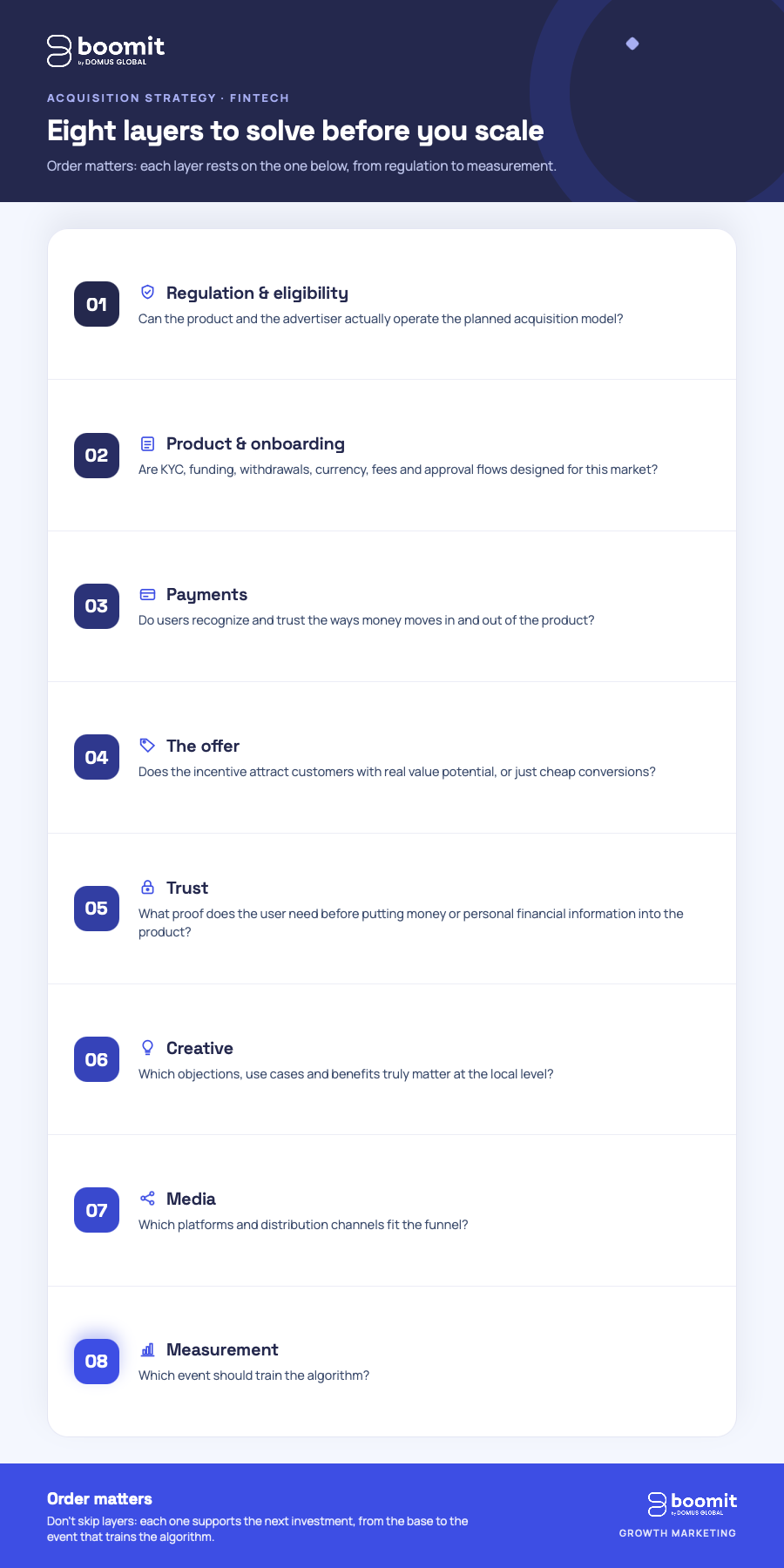
That last point is especially important. An install is not an account. An account is not an approved user. An approval is not a funded user. And a first transaction is not necessarily a valuable customer.
Measurement needs localization too
International teams often preserve one Key Performance Indicator (KPI) structure across markets for consistency. That is useful for reporting, but dangerous when the same event has different economic meaning by country.
Suppose registration is easy in one market and more selective in another. The same Cost per Registration may represent very different user quality.
Or suppose funding is almost immediate in one country because the product fits existing payment behavior, while users in another country encounter a more unfamiliar path. Optimizing both campaigns toward registration hides the difference.
A better performance model connects media with deeper product signals.
- For a lender, that might mean approvals or disbursement.
- For a wallet, first funding or transaction activity.
- For an investment platform, funded accounts or continued usage.
This is where Data Engineering and Data Analytics become part of growth. The goal is to help advertising platforms learn from signals that represent the Ideal Customer Profile (ICP), not simply the easiest available conversion.
Acquisition quality starts before retention
Retention matters, but retention teams can only work with the users acquisition brings in.
A promotion designed purely to maximize conversion can attract users who behave exactly as the campaign asks them to behave and still create poor economics.
A lending campaign can produce applications with weak approval quality. A wallet can produce registrations without funding. An investment product can acquire customers interested in the bonus rather than the service.
That is why Lifetime Value (LTV) begins with acquisition quality. The objective is not simply to generate more users and monetize them later. It is to acquire the right users from the beginning.
Localize the system, not the words
The strongest international fintechs do not need to rebuild their business from scratch in every country.
- Brand fundamentals can remain global.
- The product thesis can remain global.
- Data governance can remain global.
What needs adaptation is the interface between those global assets and local reality.
- Payments.
- Onboarding.
- Trust.
- Offers.
- Media rules.
- Creative hypotheses.
- Optimization signals.
That is the role Boomit is built to play. We connect performance marketing, Data Engineering, Data Analytics and Performance Content so growth decisions reflect what is actually happening in the local funnel.
Translation makes a campaign understandable. Localization makes the growth system work.