

“We are launching in LATAM” sounds like a strategy. In practice, it is often only a geographic decision.
A fintech can have one global product thesis, one brand and one expansion strategy for Latin America. What rarely works is assuming that Brazil, Mexico, Colombia, Chile, Argentina or Peru can then be executed through the same acquisition system with only minor adjustments.
For financial products, growth depends on much more than language. Payment infrastructure, regulation, financial inclusion, competitive intensity, trust and user expectations can change the funnel materially from one country to another. That is why the real question is not whether the strategy should be global or local. It is which parts of the strategy can travel and which need to be validated country by country before media scales.
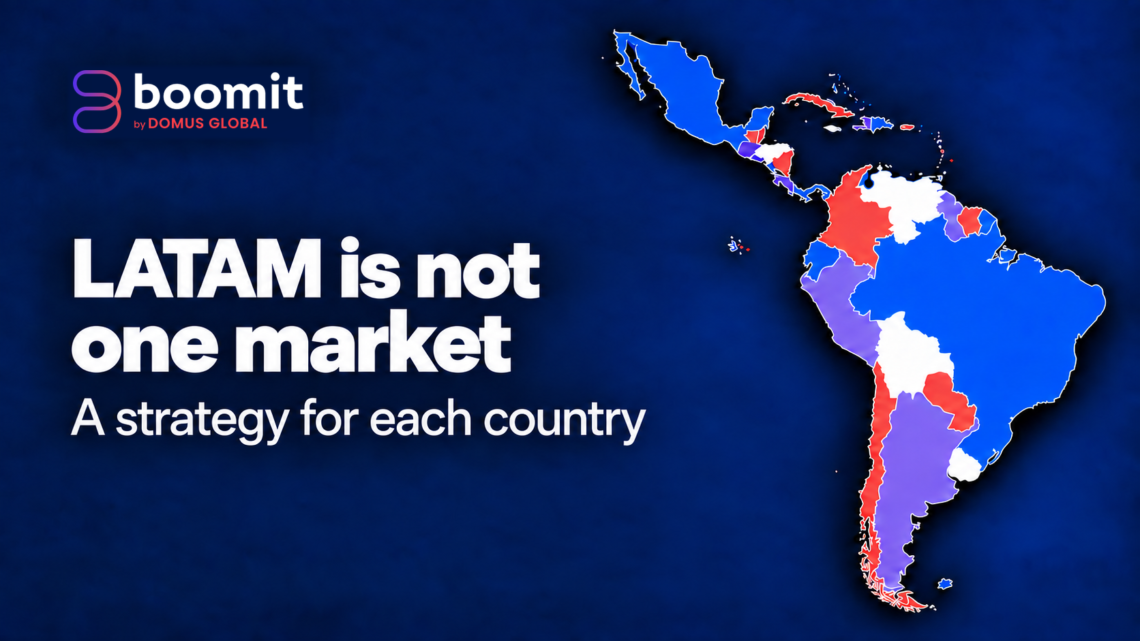
Latin America is not one fintech market
LATAM is a useful strategic region, but it is not a single operating market.
Even basic financial indicators show how different the starting point can be. According to World Bank Global Findex data for 2024, account ownership among adults reached 86.4% in Brazil, 85.1% in Chile and 81.7% in Argentina, while Colombia stood at 57.1%.
The point is not that one market is “better” than another. The point is that the same product can enter countries where users have very different levels of familiarity with financial services, digital payments and banking infrastructure.
That changes how much education the customer needs, what kind of trust signals matter, which activation event makes sense and how quickly a user can reach value.
A global team may see two campaigns with the same Cost per Acquisition (CAC) and assume performance is comparable. It may not be. If one market requires more steps, different payment behavior or stronger trust-building before funding, the same top-of-funnel result can produce completely different economics.
Even within LATAM, payment behavior starts from different places
Differences between markets do not stop at account ownership. The way people actually pay and move money also changes the context in which a financial product enters.
Chile is a useful example. According to the Banco Central de Chile’s 2025 national survey on payment usage, 81% of respondents reported using debit cards, 64% cash and 58% electronic transfers for person-to-person payments.
Those numbers matter because they describe a market where several payment behaviors coexist rather than one replacing all the others. They also hide differences inside the country itself. Cash continues to have greater relevance outside the Santiago Metropolitan Region, showing that even national averages can oversimplify the environment a growth team is entering.
Compare that with Colombia, where the starting point for financial adoption is different. World Bank data for 2024 reports materially lower account ownership than in markets such as Chile, Argentina or Brazil.
For a fintech, these differences influence more than payment operations. They can change how much education a customer needs, which use cases feel natural, how quickly users reach activation and what type of financial behavior should be considered “normal” when interpreting campaign performance.
A regional media dashboard may place Chile and Colombia next to each other. That does not mean the same funnel should behave the same way in both countries.
This is one of the reasons country-specific context matters before a team concludes that a conversion problem is simply a media problem.
Trust is local too
Financial products are unusual because the user is not only evaluating a feature. They are evaluating whether to trust a company with money.
That makes local context particularly important. An established fintech entering a new country may arrive with strong brand equity at home and almost none locally.
The global creative may emphasize a feature, while the local user is still asking more basic questions:
- Who is behind this company?
- Can I withdraw my money easily?
- Which institutions or payment methods does it work with?
- What happens if I need support?
- Are the fees clear?
- Is this product legitimate?
The competitive landscape also shapes those expectations. A new entrant is not competing in a vacuum. Local banks, wallets and fintechs have already trained users to expect certain benefits, messages, promotional mechanics and levels of service.
That means competitor analysis needs to go beyond pricing. The real question is: how are competitors acquiring trust, activation and usage in this country?
The biggest risk is the wrong diagnosis
Treating LATAM as one market does not only create bad campaigns. It creates bad conclusions.
- A low conversion rate can look like a media problem when onboarding is the real issue.
- Poor activation can look like low-quality traffic when the funding method is unfamiliar.
- High CAC can look like an expensive market when the campaign is optimizing toward the wrong event.
- Cheap registrations can look promising even if those users never become valuable customers.
This is what makes imported assumptions dangerous. They create wrong priors: expectations about how the market, funnel or customer “should” behave based on another country.
The cost is not only wasted budget. A company can incorrectly conclude that a market lacks product-market fit when the real issue is execution. Or it can scale too early because top-of-funnel numbers look attractive while downstream economics remain weak.
What a LATAM fintech growth partner should actually add
The value of a local growth partner is not simply that it speaks the language. The real value is starting with better hypotheses.
A strong partner should understand the local financial category, payment infrastructure, regulatory constraints, competitive patterns, trust signals, media environment and the relationship between acquisition events and business value.
It should also know how to connect that context with performance.
- For an app, that may mean understanding a Mobile Measurement Partner (MMP), in-app events and postbacks.
- For a lender, it may mean looking beyond leads toward approvals and disbursement.
- For a bank or wallet, it may mean separating account creation from funding and meaningful usage.
The useful distinction is not “global agency versus local agency.” It is whether the operating team can translate a global strategy into a country-specific growth system.
That is how Boomit approaches LATAM expansion. We do not believe every element should be reinvented for every country. Brand fundamentals, financial goals, product vision and data governance can remain global.
But payments, trust, media constraints, competitive context, creative hypotheses and benchmark interpretation often need local validation.
The global strategy remains intact. Execution becomes country-specific. For fintechs entering Latin America, that is usually the difference between “launching in LATAM” and actually building a market that can scale.