

Banking attribution models help identify which channels and interactions contribute to acquiring customers and signing them up for financial products. However, omnichannel journeys, lengthy decision cycles, and multiple validation stages make measurement difficult.
A user may discover a credit card through digital advertising, compare alternatives for weeks, and complete their application at a branch. If only the last interaction is considered, much of the journey is left out of the analysis.
Updating attribution models means connecting marketing data with actual business outcomes to identify which investments generate value for the business.
Why do traditional attribution models lose accuracy in banking?
Traditional models can provide an incomplete view of advertising performance when the process of signing up for a product involves multiple channels, devices, and validation stages.
The last-touch model, for example, assigns all credit to the last recorded touchpoint before conversion. This can overstate the role of channels focused on closing conversions, such as branded search or remarketing, and undervalue those that initially generate demand.
Complexity increases when branches, banking apps, and internal approval systems are involved. That is why a digital conversion does not always mean an actual customer has been acquired.
For a closer look at these differences, we recommend our article on attribution models in digital marketing.
What signals indicate that a banking attribution model is outdated?
A model needs reviewing when the results attributed to campaigns no longer accurately reflect their contribution to business outcomes.
Common signals include:
- Excessive concentration on conversion-closing channels: branded search receives much of the credit, while discovery campaigns appear unprofitable.
- Differences between platforms: Google Ads, Meta Ads, and internal systems report conversions that cannot easily be reconciled.
- Incomplete conversions: optimization focuses on submitted forms rather than activated accounts or disbursed loans.
- Fragmented journeys: interactions across devices, apps, and offline channels are not connected.
- Inconsistent budget decisions: increasing investment in seemingly efficient channels does not produce equivalent improvements in business outcomes.
These signals do not automatically prove that the model is wrong. They do, however, justify reviewing its configuration, data coverage, and ability to guide decisions.
How do you update a banking attribution model step by step?
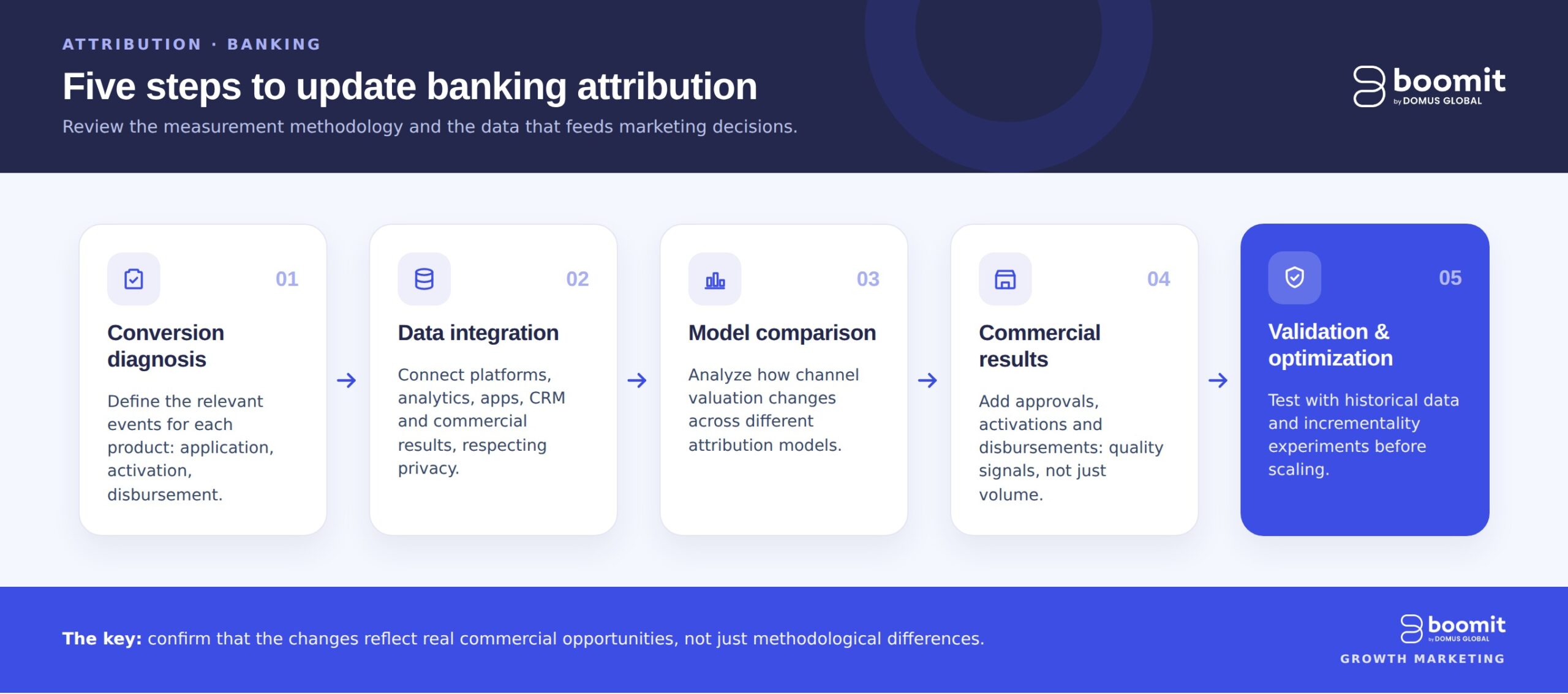
To update attribution models, you need to review both the measurement methodology and the data that informs marketing decisions.
Step 1. Define the relevant conversions for each product
Each banking product needs conversion events aligned with its business objectives. For credit cards, for example, it is useful to distinguish applications from activations, while for loans, disbursement may be more relevant than the initial form submission.
Step 2. Integrate data sources
Banking attribution requires connecting information from advertising platforms, analytics tools, apps, customer relationship management (CRM) systems, and business outcomes.
This integration must comply with applicable privacy, consent, and data processing requirements.
The goal is to reconstruct journeys without relying exclusively on cookies or advertising identifiers.
Step 3. Compare attribution models
Before changing the methodology, it is useful to analyze how different models change the assessment of each channel.
| Model | Characteristic | Main limitation |
|---|---|---|
| Last touch | Prioritizes the final touchpoint | Undervalues earlier stages |
| First touch | Highlights discovery | Ignores subsequent interactions |
| Linear | Distributes credit equally | Does not distinguish the influence of each touchpoint |
| Data-driven | Uses observed patterns to assign credit | Depends on data quality and availability |
Data-driven models can offer greater flexibility, but do not, on their own, guarantee a causal measurement of advertising impact.
Step 4. Incorporate offline conversions and quality signals
A banking model must consider what happens after the digital interaction.
Integrating approvals, activations, and disbursements helps distinguish campaigns that generate volume from those that attract customers more likely to complete the process of signing up for a product.
These signals can also be used to improve optimization on advertising platforms.
Step 5. Validate the model before scaling it
The update should be tested by comparing historical results, consistency across sources, and budget decisions.
It is also useful to run incrementality experiments, which estimate the additional results a campaign generates compared with a scenario without that intervention.
Which attribution model suits each banking product?
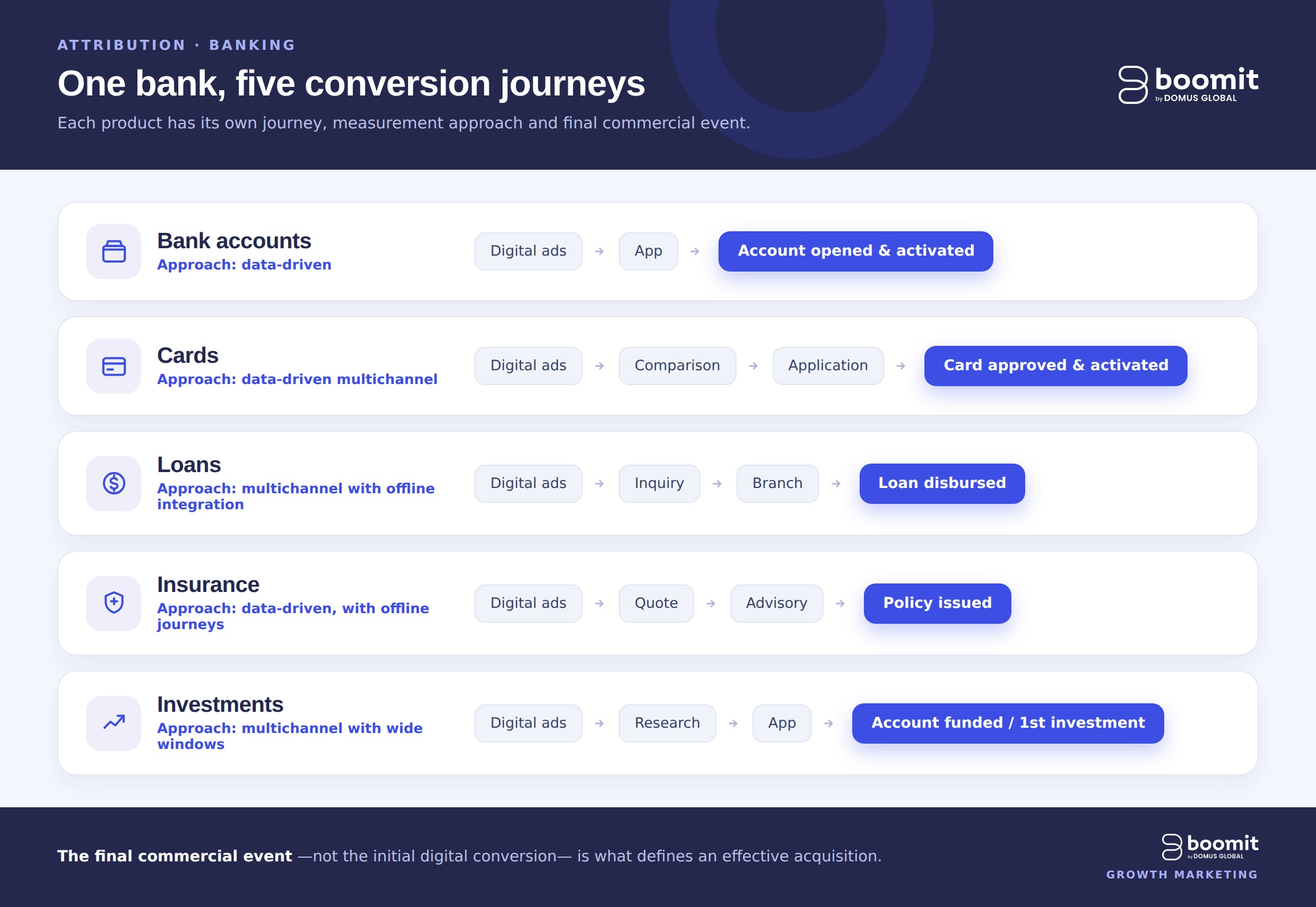
No single attribution model is suitable for every banking product. The choice depends on the decision and application cycle, the channels involved, data availability, and the business objective.
| Product | Recommended approach to evaluate | Priority conversion |
|---|---|---|
| Bank accounts | Data-driven | Account opened and activated |
| Credit cards | Data-driven multichannel | Card approved and activated |
| Loans | Multichannel with offline integration | Loan disbursed |
| Insurance | Data-driven, including offline journeys | Policy issued |
| Investments | Multichannel with broad analysis windows | Account funded or first investment |
These recommendations are starting points, not universal rules.
For example, a digital account that can be opened immediately may require a different attribution window from a mortgage, which involves multiple inquiries and validation stages.
How do you measure whether the new model improves marketing decisions?
An updated model should enable better decisions, rather than simply change the reports.
To evaluate its effectiveness, it is advisable to monitor:
- Cost per acquisition (CPA): the investment needed to achieve a valid business conversion.
- Approval or activation rate: the proportion of applications that reach the expected outcome.
- Return on ad spend (ROAS): attributable revenue relative to advertising investment, when it can be measured reliably.
- Incrementality: additional results generated by advertising activity.
How we approach it at Boomit
Our work with Banpaís illustrates the importance of connecting advertising measurement with business objectives.
We developed a digital acquisition strategy focused on generating account openings and attracting users with a greater potential to save.
Digital campaigns generated 8% of account openings, and 5% of the total balance was attributed to campaigns managed by Boomit.
This case demonstrates why measuring beyond the initial conversion matters: identifying which campaigns help acquire higher-value customers enables investment decisions that are more closely aligned with the business.
Explore the details in our Banpaís case study.
Methodology
From a growth and performance marketing perspective, we propose organizing the update around a four-dimensional framework: Data, Attribution, Quality, and Optimization.
This approach connects available sources, evaluates channel contributions, incorporates business outcomes, and uses the findings to guide investment.
The key is to avoid a common mistake: confusing an improvement in attributed conversions with actual business growth.
Before reallocating budgets, we need to verify that the changes reflect business opportunities rather than methodological differences alone.
Update your banking attribution models with Boomit
Updating attribution models helps you better understand the customer journey and optimize advertising investment based on actual business outcomes.
At Boomit, we combine growth marketing, performance marketing, and data analytics to connect data, channels, and business objectives, developing strategies focused on measurable results.
Does your bank need to improve measurement and optimize advertising investment? Discover how we can help through our Marketing Agency for Fintech & Banking.