

The customer journey is the complete path a person takes from identifying a need to interacting with, buying from, using and developing a relationship with a brand. It includes the actions, channels, decisions, emotions and friction that arise throughout that process.
For a Growth team, understanding this journey means looking beyond isolated metrics such as clicks, sign-ups or purchases. It helps explain what happens before and after each conversion and, above all, what Marketing can do to help users move to the next stage.
A customer journey map turns this path into a structured representation that helps identify friction points, communication opportunities and useful signals for acquisition and remarketing campaigns.
What is the customer journey and what is it used for?
The customer journey describes the customer experience from the customer’s own perspective. It covers more than the interactions the company planned: it also includes what people need, search for, compare and do before converting.
It helps answer specific questions: how does a user discover our product? What information do they need before signing up? What holds them back? Which channels are involved? Why do some users move forward while others drop off?
That is why it is not exactly the same as a sales funnel. The following table shows some differences between the two:
| Aspect | Customer journey | Sales funnel |
|---|---|---|
| Perspective | Customer | Company |
| Focus | Experience and behavior | Conversion |
| Structure | Can be nonlinear | Simplifies the process into stages |
| Analyzes | Needs, actions, emotions and touchpoints | Volume and conversion between stages |
| Main question | Why does the user move forward or drop off? | How many users move forward? |
The two models complement each other. The funnel shows where conversion drops; the customer journey helps investigate what may be causing it.
What are the stages of the customer journey?
There is no single sequence that works for every business. A financial app and a B2B service, for example, can have very different journeys.
For digital products, however, we can work with five broad stages.
Customer journey stages
- Discovery. The user identifies a need or problem and encounters a potential solution. This may happen through Google, a recommendation, content or advertising on Meta, TikTok, YouTube or another platform.
- Consideration. The user now understands their need better and compares alternatives. They visit pages, explore benefits, look for reviews or engage with ads again. A clear value proposition becomes critical.
- Conversion. The user decides to take action: downloading an app, opening an account, requesting a product, making a purchase or completing the event that represents value for the business. At this stage, any friction in forms, onboarding or requirements can affect conversion.
- Activation and use. A sign-up does not mean you have acquired a good customer. A fintech may need the user to fund their account for the first time, request a card or complete a transaction before considering them truly activated.
- Loyalty and advocacy. The product is now part of the user’s behavior. Frequency, repeat usage and perceived value determine whether they will keep using it and be willing to recommend it.
For Performance Marketing, the key is to avoid optimizing solely for the first available conversion. The more an advertising platform can learn from signals associated with high-value users, the better acquisition can align with the business.
Customer journey map: what it is and what it includes
A customer journey map is a visual representation of the path a customer takes through their different interactions with a company.
A useful customer journey map should include at least seven elements: stage, user goal, action taken, touchpoint, emotion or expectation, identified friction and opportunity for improvement.
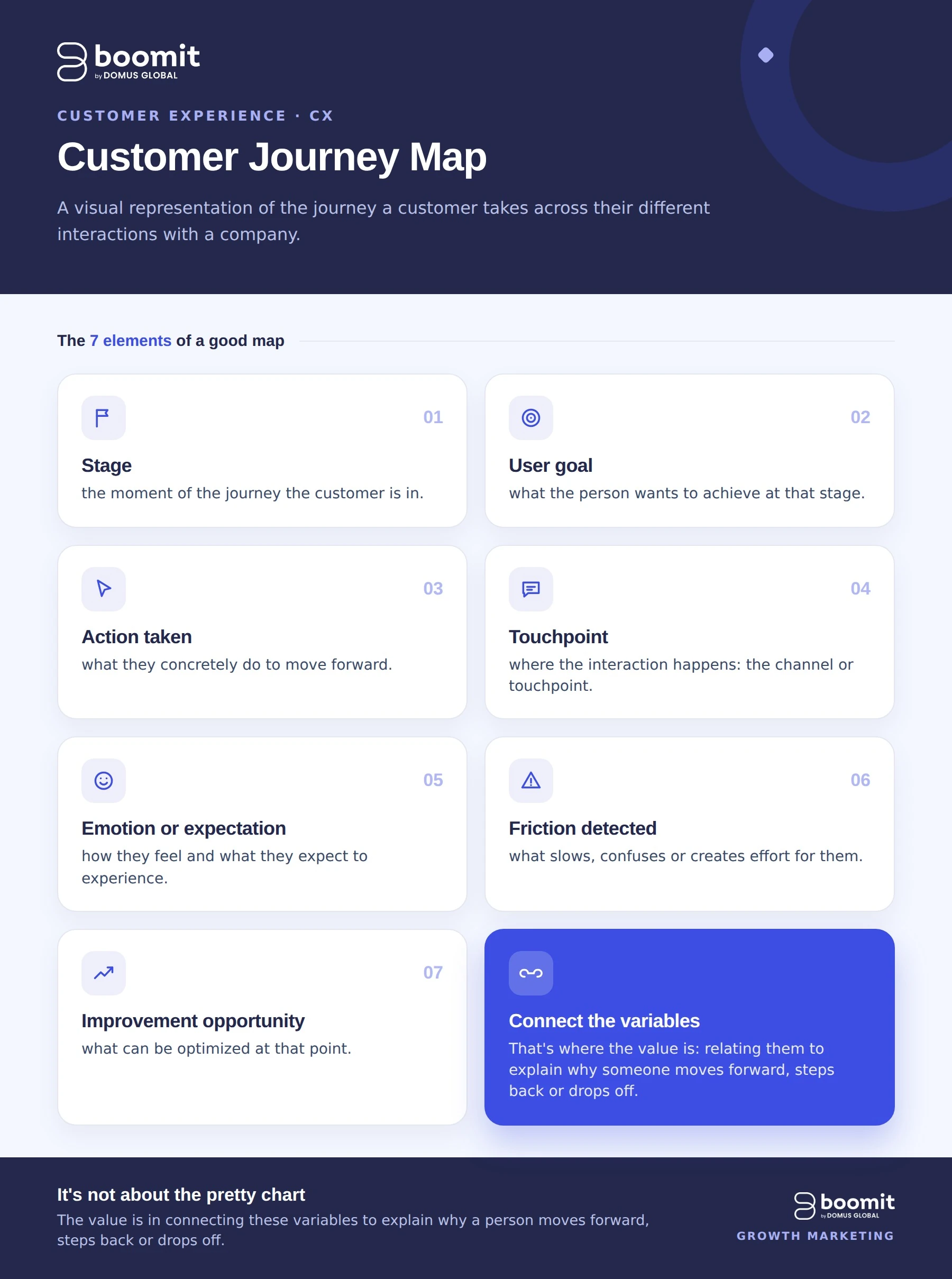
The value is not in creating a visually appealing chart. It lies in connecting these variables to explain why a person moves forward, goes back or drops off.
How to create a customer journey map step by step
To create a customer journey map that supports business decisions, follow an evidence-based process:
- Define the segment you will analyze. Avoid building a universal journey. A high-value user may take a different path from someone who drops off after signing up.
- Define the goal of the journey. This could be opening an account, signing up for a service, making a purchase, funding a wallet or completing another relevant event.
- Reconstruct the actual stages. Analyze how the user moves from discovery to conversion and use.
- Identify the touchpoints. Ads, search engines, landing pages, the App Store, emails, WhatsApp, push notifications, the product and support may all be part of the same journey.
- Add behavioral data. Web or product analytics, attribution tools, CRM (Customer Relationship Management) systems and advertising platforms help replace assumptions with evidence.
- Identify friction. Look for moments when conversion rates fall, drop-off increases or users need to make too much effort to continue.
- Turn findings into experiments. Each opportunity should translate into an action: changing an ad creative, updating a landing page, adjusting audiences, simplifying onboarding or testing another message.
A practical customer journey map example
Imagine a fintech that offers a digital account. The goal should go beyond generating installs: it should explain the journey that takes a user from discovery to their first transaction.
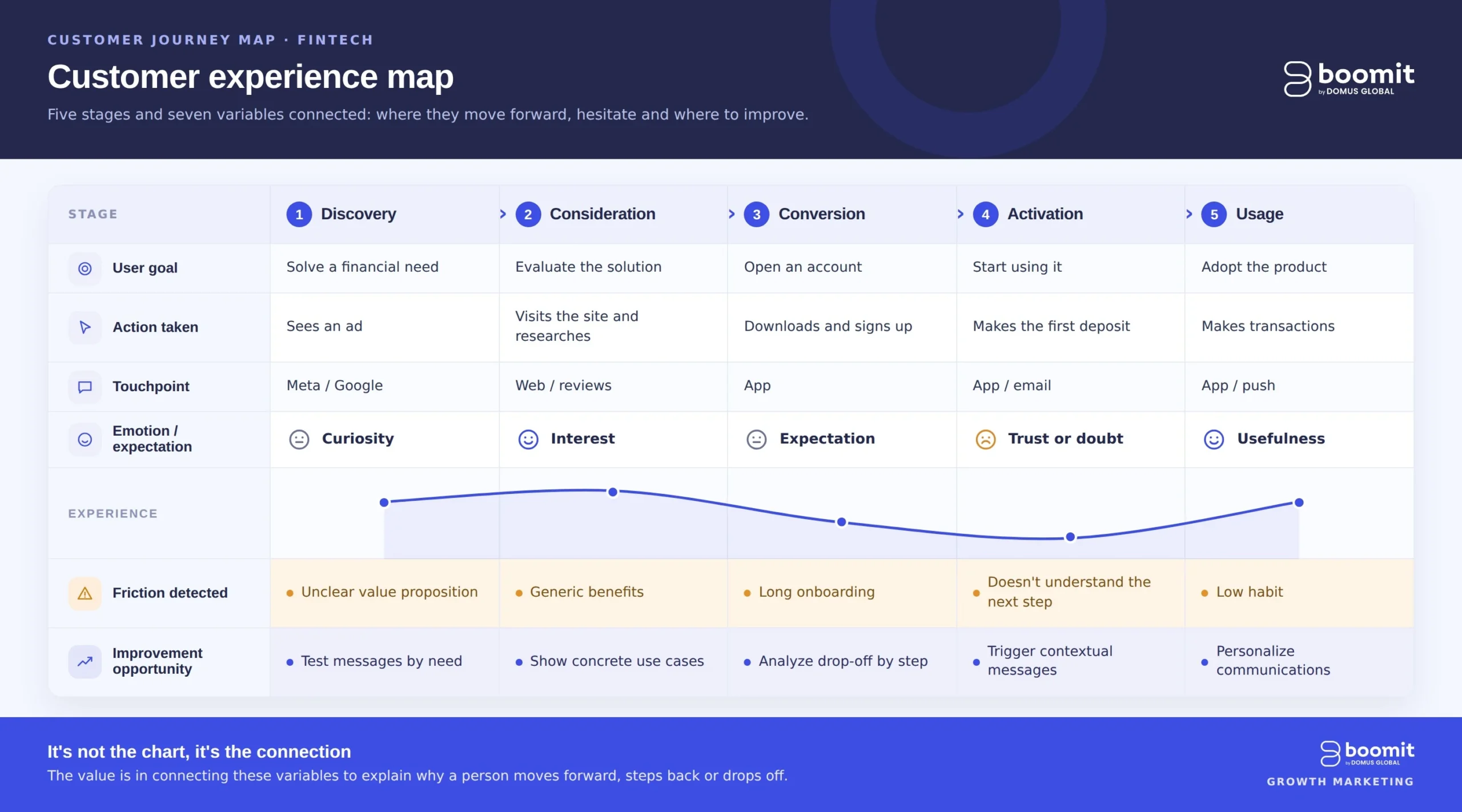
This table reveals an important point: acquisition problems do not always stem from advertising. A campaign can generate sign-ups efficiently while acquiring users who never complete the event that actually represents value.
Improve your company’s customer journey with Boomit
At Boomit, mapping the journey is just the beginning. The real value emerges when the map connects with tracking, campaigns, creative work and investment decisions.
The customer journey then becomes more than a static chart: it becomes a tool for developing better growth marketing strategies.
Be careful about building the map exclusively from the team’s perspective. Without data to support the journey, we end up documenting how we think customers behave.
Understanding the customer journey allows you to analyze acquisition from a broader perspective than a traditional funnel. It is not just about knowing how many people convert, but also understanding what they need, what they do and which obstacles they encounter along the way.
A useful customer journey map connects that experience with data and decisions. When integrated with creative work and Performance Marketing, it can help identify better acquisition signals and direct investment toward users who actually generate value.
If you want to turn your users’ journey into a measurable acquisition and growth strategy, explore how we work at Boomit as a Growth Marketing Agency.