

Acquiring a customer is only one part of growth. The real challenge comes afterward: getting them to return, use the product regularly, and generate lasting value.
That is why a growth strategy should measure more than how many customers it acquires. It should also track what happens after they convert.
Customer loyalty encompasses the strategies designed to build long-term relationships, encourage repeat usage, and reduce churn. But building loyalty means more than creating a points program or sending promotions. It means understanding which customers we are acquiring, what led them to convert, how they use the product, and which experiences can increase their value over time.
What is customer loyalty, and why does it matter?
Building customer loyalty is the process through which a company encourages customers to keep choosing, using, and recommending its products or services over time.
A loyal customer is more than a satisfied customer. They find enough value in the product to make it part of their routine and use it again, even when alternatives are available.
Loyalty, retention, and repeat usage: what is the difference?
The three layers of customer relationships
Engagement and retention. From repeated action to lasting preference: each level is deeper and more valuable.
| Concept | What it represents | Example |
|---|---|---|
| Loyalty | The customer's lasting relationship and preference | A user consistently chooses the same fintech |
| Retention | The ability to keep customers active | The user remains active after 6 months |
| Repeat usage | The repetition of a meaningful action | The user makes several transactions during the month |
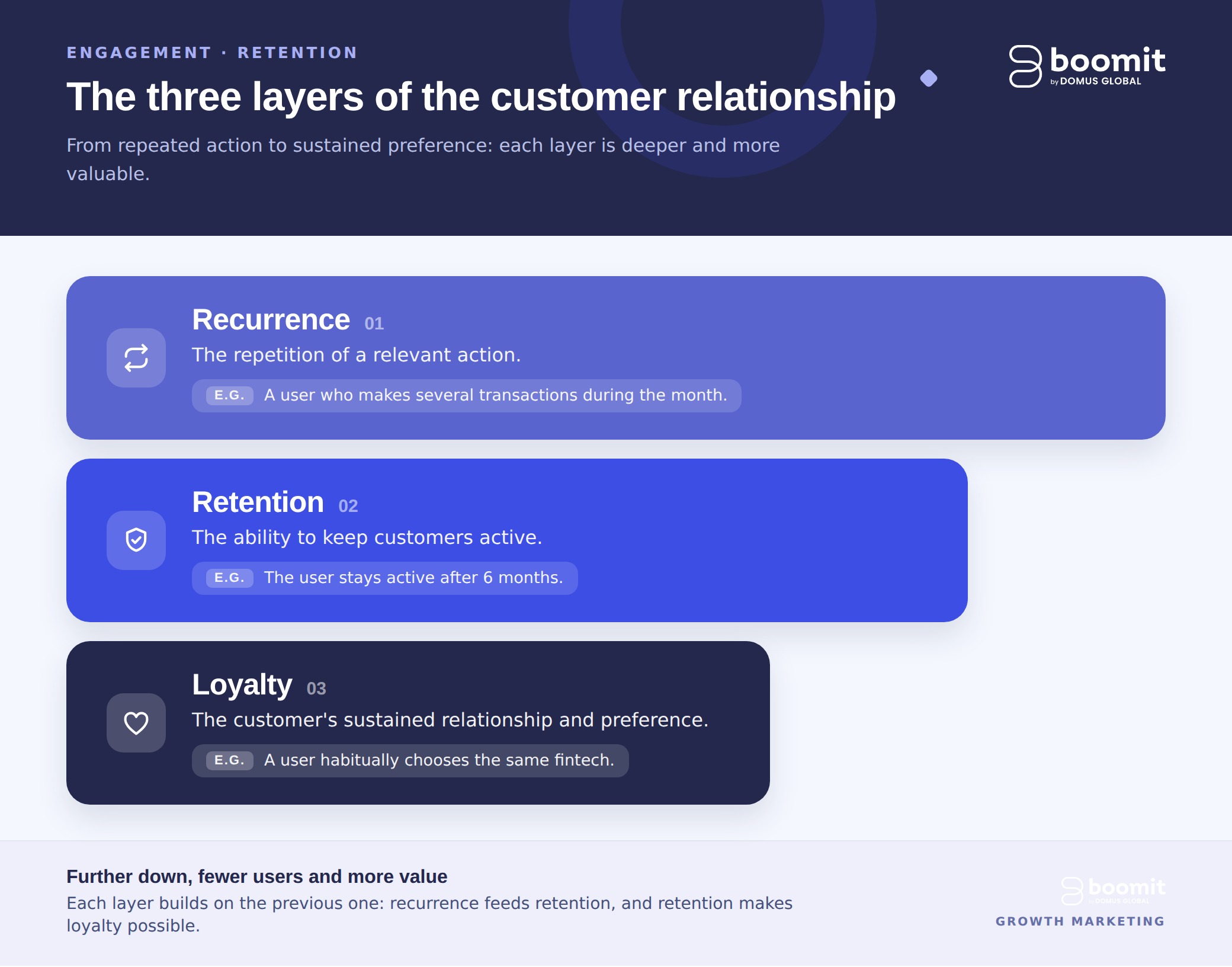
These three concepts are related, but examining them separately helps us better understand customer behavior.
Why is customer loyalty important?
Because it changes the economics of growth.
If a company continually invests in acquisition but users leave quickly, it needs to replace them to sustain its results. When users stay active, make further transactions, or sign up for other products, however, the value generated by each acquisition can increase.
That is why loyalty is directly related to customer lifetime value (LTV): how much value a customer generates throughout their relationship with the business.
Yet traditional loyalty strategies often overlook one point: repeat usage also depends on the quality of the customer we acquire in the first place.
A campaign can achieve a low cost per acquisition and still attract users who are unlikely to activate or use the product regularly. Acquisition and loyalty should therefore be considered together.
Customer loyalty strategies that increase repeat usage, with examples
There is no single strategy for building customer loyalty. The right combination depends on the product, its business model, and, above all, the behavior that creates value for the company.
Strategy 1: acquire customers with the potential to generate value
Building loyalty can begin even before someone becomes a customer.
This requires looking beyond sign-ups and using signals from later in the funnel to understand which campaigns, audiences, and messages are attracting higher-quality users.
Real example: Banpaís + Boomit. The bank needed to attract savings deposits, rather than simply generate leads. At Boomit, we developed a strategy based on value-based segmentation and creative assets that could prequalify users according to the product’s actual terms. The result was an acquisition strategy focused on people with a real capacity to save, rather than mass volume.
Strategy 2: optimize for what customers do after converting
An early conversion does not always represent value for the business.
Integrating later events—such as activation, account funding, purchases, or transactions—helps identify which users actually move forward and use that information to improve future acquisition.
Real example: peiGo + Boomit. In our work with the Ecuadorian fintech, we connected critical funnel events and restructured campaigns to feed algorithms signals such as active users and usage frequency, rather than optimizing solely for installs.
As a result, insights into users’ subsequent behavior also began to improve acquisition decisions.
Strategy 3: turn repeat usage into an optimization signal
A more advanced strategy uses repeat usage as both a KPI (key performance indicator) and an input for marketing optimization.
The first step is to define which repeated behavior generates value. The next is to connect that signal to the measurement and acquisition ecosystem.
Real example: TraderPal + Boomit. We implemented a data architecture that connected deeper business events with Google, Meta, and TikTok. As the project progressed, campaigns were able to optimize all the way to recurring investments, beyond sign-ups or leads.
This case shows how a metric traditionally associated with loyalty can become an active signal for improving growth marketing.
Strategy 4: design growth around actual product usage
Loyalty increases when a strategy shifts its focus from pursuing users to pursuing behaviors that demonstrate adoption.
This requires defining what it really means for a customer to make the product part of everyday life.
Real example: Kash + Boomit. In Central America, we worked on a strategy that integrated acquisition, activation, and transaction generation. The focus expanded beyond installs or sign-ups toward the behavior that creates value for Kash: users who adopt the fintech and actually use it to move money.
Growth in each market also boosted cross-border transfers and increased the value of the regional network.
Strategy 5: connect loyalty with economic value
More repeat usage does not always mean greater profitability. A loyalty strategy needs to connect behavior with economic value.
This means connecting CAC (customer acquisition cost), frequency, revenue, and LTV to identify which segments justify greater investment.
Real example: Monific + Boomit. The strategy shifted from optimizing for sign-ups to optimizing for actual investors, connecting the data infrastructure with investment signals. This made it possible to understand how much it cost to acquire an investor, how much revenue they generated over their lifetime, and use that information to make investment and scaling decisions.
How we do it at Boomit
At Boomit, we see loyalty as part of the complete growth marketing system. We can summarize this approach in four stages: Acquire, Detect, Experiment, and Repeat.
- Acquire: attract users with a real potential to generate value.
- Detect: connect data to identify behaviors, segments, and signals of repeat usage or churn.
- Experiment: test audiences, messages, creative assets, and incentives.
- Repeat: turn lessons learned into actions that increase activation, usage, and value.
The cycle starts again because the data generated after acquisition helps improve the campaigns that will bring in the next customers.
This integration of marketing, technology, and analytics is part of our approach as a Growth Marketing Agency.
How do you measure a customer loyalty strategy?
There is no single loyalty metric. Indicators must reflect the behavior that generates value for each business.
| Metric | What it helps you understand |
|---|---|
| Retention Rate | What percentage of customers remains active |
| Churn Rate | What percentage stops using the product |
| Repeat Purchase Rate | How many customers buy again |
| Usage frequency | How often customers perform the meaningful action |
| LTV | How much value customers generate throughout their relationship with the business |
| NPS | How willing customers are to recommend the brand |
A transaction-focused fintech, for example, may prioritize active users, frequency, and transaction volume. A subscription product is likely to pay closer attention to churn and retention.
Mistakes to avoid
One of the main mistakes is measuring only initial conversions. Another is assuming that offering discounts automatically builds loyalty.
It is also best to avoid treating all customers as one group. Cohorts let you compare users acquired in different periods, through different channels, or through different campaigns, revealing differences that averages can hide.
Checklist for improving customer loyalty
Before launching a new strategy, it is worth answering five questions:
- Do we know which behavior represents repeat usage for our business?
- Can we identify which customers are most likely to repeat it?
- Do we connect acquisition data with subsequent behavior?
- Can we use those signals to improve campaigns and communications?
- Are we measuring value generated, beyond conversions alone?
If any answer is “no,” there is probably an opportunity for growth before adding more discounts or rewards programs.
Increase customer loyalty with Boomit
Building customer loyalty does not begin when someone is about to stop using the product.
It begins much earlier: with the audiences we choose to attract, the expectations we create, the signals we send to algorithms, and the behaviors we choose to optimize after conversion.
The Banpaís, peiGo, TraderPal, Kash, and Monific cases show different parts of the same logic: acquire quality customers, understand what they do next, and use that information to generate more value.
When acquisition, behavior, and data work as parts of the same system, the goal moves beyond simply acquiring more customers.
It becomes acquiring customers who can generate more value for longer.
At Boomit, we connect growth marketing, performance marketing, data analytics, and technology to build strategies aimed at that goal.
Want to increase repeat usage and customer value? Let’s talk.